Water Treatment Chemicals: An Operator's Guide
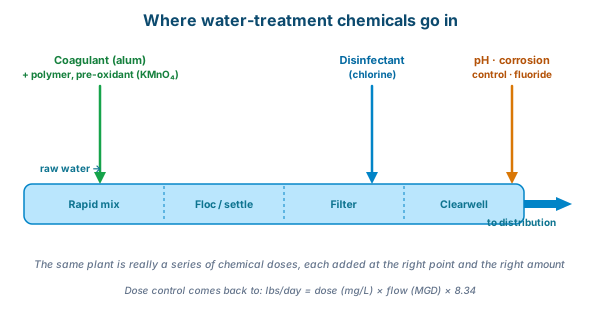
Strip a water treatment plant down to its essence and it's a sequence of chemical doses applied in the right place and the right amount. Coagulant to clump the dirt, an oxidant to knock out iron and odors, a disinfectant to kill pathogens, something to fix the pH, and a corrosion inhibitor to protect the pipes on the way out. Knowing what each chemical does, and how you control it, is the heart of being an operator. Here's the working operator's rundown, organized by the job each chemical does rather than by its formula.
Key takeaways
- Operators think about chemicals by what they do, not by their name: coagulate, oxidize, disinfect, adjust pH, control corrosion, fluoridate, and (in wastewater) dechlorinate.
- Coagulants like aluminum sulfate (alum) and ferric chloride neutralize the charge on tiny particles so they clump and settle; the dose is set by the jar test.
- Oxidants like potassium permanganate (KMnO₄) and chlorine handle iron, manganese, taste, and odor.
- Chlorine (as gas, sodium hypochlorite, or calcium hypochlorite) is the workhorse disinfectant; you control it by residual and contact time (CT).
- pH and alkalinity get tuned with lime, caustic soda (sodium hydroxide), or soda ash: important for coagulation, disinfection, and corrosion.
- Almost every dose comes back to one formula: lbs/day = dose (mg/L) × flow (MGD) × 8.34. Practice it on the chemical feed test and the dosage calculator.
Coagulants and flocculants: making particles clump
Raw water carries tiny suspended particles (clay, silt, organics) that are too small and too similarly charged to settle on their own. Coagulants fix that by neutralizing their charge so they can stick together.
- Aluminum sulfate (alum), the classic municipal coagulant. Cheap, effective, well understood; it works best in a fairly narrow pH band and consumes alkalinity.
- Ferric chloride and ferric sulfate: iron-based coagulants that work over a wider pH range and often produce a denser, faster-settling floc.
- Polyaluminum chloride (PACl): a pre-hydrolyzed coagulant that performs across a broad pH range, consumes less alkalinity, and makes less sludge. Increasingly popular.
After the coagulant flash-mixes in, flocculant aids (polymers), long-chain anionic, cationic, or nonionic polymers: bridge the small particles into bigger, tougher floc that settles or filters out more easily. (Polymers also do heavy duty in sludge dewatering.)
The operator's control tool here is the jar test: run several doses side by side and pick the one that forms the best-settling floc and clearest water. Too little coagulant and the water stays cloudy; too much wastes chemical and can re-stabilize the particles. (Go deeper in coagulants compared and jar testing.)
Oxidants: iron, manganese, taste, and odor
Some problems aren't about particles; they're about dissolved metals and smells. Oxidants convert dissolved iron and manganese into solid, filterable forms and destroy taste-and-odor compounds.
- Potassium permanganate (KMnO₄), a purple oxidant that's a workhorse for iron and manganese removal and taste/odor control. It's potent, so it's dosed carefully, overdose and you get pink water. (See iron and manganese removal.)
- Chlorine, also an oxidant (pre-chlorination) in addition to its disinfectant role.
- Ozone and chlorine dioxide: stronger oxidants used for tougher taste/odor and some contaminants, without forming the same chlorination byproducts.
Disinfectants: killing the pathogens
This is the non-negotiable job: inactivate the bacteria, viruses, and protozoa that make water unsafe. Chlorine is the dominant disinfectant, delivered three ways:
- Chlorine gas (Cl₂): concentrated and economical for larger plants, but a serious safety hazard that demands careful handling and leak detection.
- Sodium hypochlorite: liquid bleach (typically 12.5%), safer to handle, common at small and mid-size plants.
- Calcium hypochlorite: a dry solid (tablets/granules), handy for small systems and well disinfection.
You control disinfection by CT, concentration × contact time, holding enough residual for long enough to do the kill. Where ammonia is present (or to carry a longer-lasting residual into distribution), plants form chloramines by adding ammonia to chlorine. (See breakpoint chlorination, free vs. combined chlorine, and CT calculations.)
pH and alkalinity adjustment
pH quietly controls almost everything: how well coagulation works, how strongly chlorine disinfects, and whether your water eats pipes or protects them. Operators raise or lower it with:
- To raise pH / add alkalinity: lime (calcium hydroxide or quicklime: which also softens), caustic soda (sodium hydroxide, NaOH), or soda ash (sodium carbonate).
- To lower pH: carbon dioxide (CO₂) or acids like sulfuric acid.
Lime does double duty: besides pH, it's the core chemical in lime-soda ash softening, where lime and soda ash precipitate out calcium and magnesium hardness.
Corrosion control: protecting the pipes (and meeting the Lead and Copper Rule)
Water that's even slightly aggressive will dissolve metal from the distribution system: including lead and copper from service lines and household plumbing, a direct public-health and regulatory concern. Operators control it two ways:
- pH and alkalinity adjustment to push the water toward depositing a thin protective scale instead of dissolving metal (the balance the Langelier Index describes).
- Corrosion inhibitors, orthophosphate and blended/polyphosphates, which lay down a protective film on pipe interiors.
This is "optimized corrosion control treatment," and it's exactly what the Lead and Copper Rule pushes systems to dial in.
Fluoride
Many systems add fluoride for dental health, using fluorosilicic acid (the most common), sodium fluorosilicate, or sodium fluoride. It's tightly dose-controlled to a target around the optimal level set by health authorities, enough for benefit, never more.
Dechlorination: the wastewater finish
On the wastewater side, plants that chlorinate usually have to remove that chlorine residual before discharge, because it's toxic to fish and aquatic life. The dechlorination chemicals are sulfur dioxide (SO₂) gas or, increasingly for safety, sodium bisulfite / sodium metabisulfite. They react almost instantly with chlorine to neutralize it. (See wastewater disinfection: chlorine vs. UV.)
The operator's real job: dose, feed, and stay safe
Knowing the chemicals is half of it. Running them is the other half:
- Dosing math. Almost every chemical decision comes back to the pounds formula: lbs/day = dose (mg/L) × flow (MGD) × 8.34. Get comfortable with it, it's on every exam and used every shift. (Practice on the dosage calculator and operator math formulas.)
- Feed equipment. Metering pumps, gas chlorinators, dry feeders, and day tanks, each needs calibration so the dose you intend is the dose the water gets. A "calibrated drawdown" check confirms a pump's actual output.
- Safety. Chlorine gas, strong acids and caustics, and oxidizers are genuinely hazardous. PPE, proper storage and separation of incompatible chemicals, leak detection, and following the SDS aren't optional.
Practice it
Chemical types, doses, and feed control are heavily tested across drinking-water and wastewater exams. Drill them on the chemical feed & dosing practice test, the disinfection test, and the coagulation test, and pair this with coagulants compared, jar testing, and corrosion control and the Langelier Index. For the dosing math, use the chemical dosage calculator.
This guide is a free study aid covering general water-treatment practice. Chemicals, doses, target levels, and handling requirements vary by facility and regulation: always follow your plant's process-control program, the chemical SDS, and your state's requirements, and confirm specifics with your supervisor. Reviewed June 2026.