Chemical Dosage Calculator
Enter your dose and flow to get pounds per day of chemical, plus gallons per day and pump mL/min.
Inputs
Result
Show formula with your numbers
How chemical dosage math works
The fundamental water-treatment dosage formula is:
The 8.34 constant is the weight of one gallon of water in pounds. It converts the mg/L concentration (a parts-per-million measure) and the MGD flow (a millions-of-gallons-per-day measure) into pounds per day of the active chemical.
When you're using a commercial stock solution that is less than 100% active, for example, 12.5% sodium hypochlorite, 49% alum, or 6.25% bleach, you have to scale up the solution feed rate so the active chemical delivered hits your target dose. Divide the lbs/day by the decimal active strength to get lbs/day of solution. To convert lbs/day to gallons/day, divide by (8.34 × specific gravity).
Worked example
Goal: dose 2 mg/L of chlorine into a 3 MGD treatment plant using 12.5% sodium hypochlorite (specific gravity 1.16).
- Pounds of chlorine per day = 2 × 3 × 8.34 = 50.04 lbs/day of 100% chlorine
- Pounds of 12.5% solution per day = 50.04 / 0.125 = 400.3 lbs/day of stock
- Gallons of stock per day = 400.3 / (8.34 × 1.16) = 41.4 gallons/day
- Pump setting in mL/min = 41.4 gal/day × 3785 mL/gal ÷ 1440 min/day = 108.8 mL/min
Typical water-treatment chemical doses
Use these typical ranges as a sanity check on your calculated dose. Actual doses always depend on raw water quality, treatment goals, and bench-scale testing.
| Chemical | Purpose | Typical dose | Common stock strength |
|---|---|---|---|
| Chlorine (Cl₂ / NaOCl) | Disinfection | 1–4 mg/L free Cl₂ | 12.5% NaOCl (SG ≈ 1.16) or 100% Cl₂ gas |
| Alum | Coagulation | 10–60 mg/L | 49% liquid alum (SG ≈ 1.33) |
| Ferric chloride | Coagulation | 5–40 mg/L | 30–40% FeCl₃ (SG ≈ 1.40) |
| PACl | Coagulation | 5–30 mg/L | 10% PACl as Al₂O₃ |
| Polymer (cationic) | Coag aid / flocculation | 0.1–1 mg/L | 0.5% (diluted from neat product) |
| Lime (CaO) | Softening / pH up | 50–300 mg/L | Dry / slurry |
| Caustic soda (NaOH) | pH adjustment | 5–30 mg/L | 25% NaOH (SG ≈ 1.27) |
| Soda ash (Na₂CO₃) | pH / alkalinity up | 10–80 mg/L | Dry feed |
| Fluoride (HFS) | Fluoridation | ≤ 0.7 mg/L F⁻ (target) | 23–25% fluorosilicic acid |
| Orthophosphate | Corrosion inhibitor | 0.5–3 mg/L as PO₄ | 30% blended ortho/poly |
Common operator dosage mistakes
- Forgetting to scale up for stock-solution strength. A 12.5% bleach product is only 12.5% active chlorine. If your dose math gives 10 lbs/day of chlorine, you actually need 80 lbs/day of bleach solution.
- Mixing flow units. The formula is in MGD. If your SCADA reports gpm, convert first: gpm × 1,440 ÷ 1,000,000 = MGD. The unit selector on this calculator does it for you.
- Confusing weight % with volume %. Most water-treatment chemicals are sold by weight percent. Specific gravity matters when converting pounds to gallons. The default SG of 1.0 only works if your stock solution is mostly water at low concentration.
- Using residual instead of dose. The 8.34 formula gives the chemical added. After demand from the water, the residual you measure downstream will always be lower. Match the calculated dose to your target dose, not target residual.
- Assuming gas chlorinator readings are mg/L. Most gas chlorinators read in lbs/day directly. You still divide by flow × 8.34 to back-calculate the dose.
When to use this calculator
Use it for setting initial feed rates on chlorine, alum, ferric, polymer, caustic, soda ash, fluoride, and corrosion inhibitor systems; for studying the lbs/day math problems on the certification exam; and as a quick check against your plant's existing setpoints. It assumes the stock solution is well mixed at the stated active strength. For solid (powder) feeders, use only the lbs/day output and ignore the gallons/day field.
Frequently asked questions
How do you calculate chemical dosage in water treatment?
What is the 8.34 factor in the chemical dosage formula?
How do you calculate the dose of 12.5% sodium hypochlorite (bleach)?
Are mg/L and ppm the same thing?
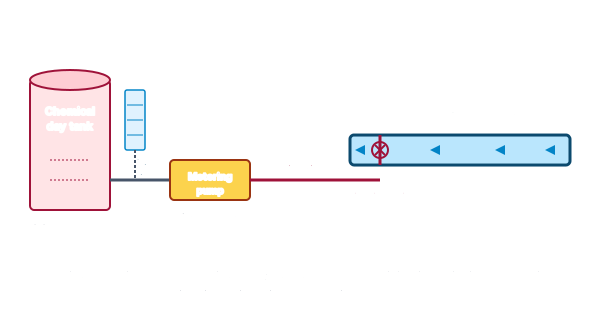
How do I set my metering pump from a dosage calculation?
Related practice tests
Free practice tests covering dosage math, chemical feed setup, and disinfection:
Other operator calculators
- Silt Density Index (SDI) calculator, fouling potential of RO/NF feed water
- Langelier Saturation Index (LSI) calculator, corrosive vs. scale-forming water
- See all calculators →
Disclaimer: This calculator is provided as a free study aid. Always verify chemical feed rates against your facility's standard operating procedures and applicable state and federal regulations before adjusting any feed equipment. For specific regulatory references see the EPA Drinking Water Regulations.