Coagulants Compared: Alum, Ferric Chloride, PACl, and Polymers
The label on the chemical tote says aluminum sulfate, or ferric chloride, or polyaluminum chloride. The difference between those names isn't trivial: each one has a different pH window, a different alkalinity hit, a different sludge volume, and a different price per pound of turbidity removed. The exam tests these distinctions. The plant tests them too: an operator who switches from alum to ferric without adjusting pH or alkalinity ends up with corroded distribution mains and a regulatory letter.
This guide walks through the five coagulants you'll actually see in U.S. water plants, alum, ferric chloride, ferric sulfate, polyaluminum chloride (PACl), and the cationic polymers that ride along with them, and how to choose between them.
Key takeaways
- Alum (aluminum sulfate, Al₂(SO₄)₃·14H₂O) is the workhorse: cheap, available, pH window 5.5–7.5, consumes about 0.5 mg/L of alkalinity per mg/L of alum, produces a fluffy aluminum-hydroxide floc.
- Ferric chloride (FeCl₃) works over a wider pH range (4.5–9), produces denser floc, removes more organics than alum, but is corrosive to handle and produces more sludge per mg/L.
- Ferric sulfate (Fe₂(SO₄)₃) behaves similarly to ferric chloride but adds sulfate instead of chloride to finished water, useful where chloride-sensitive distribution materials matter.
- PACl (polyaluminum chloride) is the modern premium choice: works at lower doses, tolerates pH 6–9, consumes less alkalinity than alum, and produces less sludge. Costs more per gallon, but often costs less per pound of turbidity removed.
- Cationic polymers aren't primary coagulants on most plants, they're either filter aids or coagulant aids that bridge floc together. They don't consume alkalinity.
- Test what you've learned with the coagulation/flocculation practice test, and use the chemical dosage calculator to size full-scale doses.
How coagulation actually works
Before the chemistry, the physics. Raw surface water carries colloidal particles, clay, silt, organic matter, algal fragments, that are small enough (less than 1 micron) to stay suspended for weeks. They stay suspended because they carry a negative surface charge, and like charges repel. The colloids never come close enough to stick to each other and settle.
A coagulant fixes that by introducing a positive charge that neutralizes the colloid surface. Trivalent metal salts, aluminum (Al³⁺) and iron (Fe³⁺), hydrolyze in water to form hydroxide complexes that carry strong positive charges. Those positive complexes glom onto the colloid surfaces, drop the surface charge to zero, and now the colloids can collide and stick.
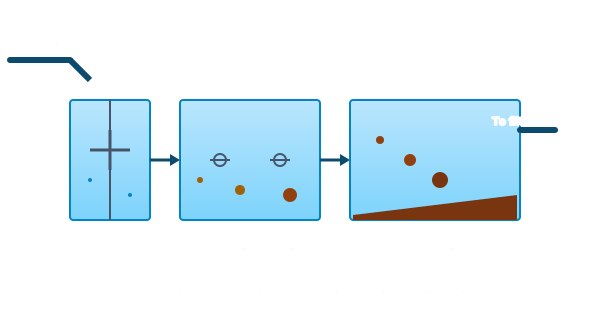
Once they stick, the slow-mix step in flocculation lets them grow into settleable floc. The settled floc carries the colloids, and most of the turbidity, out of the water column. That's the whole process: charge neutralization, then floc growth, then settling.
Different coagulants do that job with different chemistry. Here's how the five common ones compare.
1. Alum (aluminum sulfate)
The default coagulant in U.S. water treatment. Sold as a 48.5% liquid (dry weight basis) or as dry granules. Dose ranges 10–80 mg/L for most surface waters, with 20–40 mg/L being typical.
Chemistry. Alum is acidic in water, it consumes alkalinity to drive the hydrolysis reaction. Roughly 0.5 mg/L of alkalinity (as CaCO₃) is consumed per mg/L of alum added. A plant adding 40 mg/L of alum consumes about 20 mg/L of alkalinity. If raw-water alkalinity is below about 30 mg/L, the alum reaction stalls: the operator has to either add lime or soda ash to restore alkalinity, or switch coagulants.
pH window. Active range is 5.5–7.5. Outside that window, aluminum doesn't hydrolyze efficiently and the floc doesn't form. Most surface waters in the U.S. sit at pH 6.8–8.2, so alum often works as-is. High-pH lake water in summer (above 8.2) sometimes needs pH adjustment first.
Sludge. Alum sludge is light, fluffy, hard to dewater, and hard to dispose of. Roughly 0.6 lb of sludge per pound of alum, on a dry-weight basis. Some states classify alum sludge as hazardous; most don't, but the volume is the bigger problem.
Finished water. Trace residual aluminum can appear in finished water if alum dose is high and pH is off. EPA's secondary MCL for aluminum is 0.05–0.2 mg/L, not health-based, but high finished-water aluminum is a flag.
When to pick alum. Default for clean surface water with adequate alkalinity (over 30 mg/L) and pH between 6.5 and 7.8. Cheap and available everywhere.
2. Ferric chloride
The choice when alum can't do the job. Sold as a 38–40% liquid solution. Dose ranges 15–80 mg/L, often slightly higher than alum on the same water.
Chemistry. Ferric chloride is even more acidic than alum in water, it consumes about 0.9 mg/L of alkalinity per mg/L of FeCl₃. Higher alkalinity demand than alum.
pH window. Active range is 4.5–9, much wider than alum. Ferric works at low pH (acidic mountain streams, sometimes), and works at high pH where alum fails. The wider window is the main reason a plant might switch to ferric.
Sludge. Ferric sludge is denser than alum sludge, settles faster, and dewaters better. Sludge volume per mg/L of coagulant is similar to alum, but the sludge handles better.
Finished water. Trace iron can show up in finished water if doses are too high or pH is off, and iron stains laundry and fixtures. EPA's secondary MCL is 0.3 mg/L. Operators watch the finished iron number on every shift.
Operator handling. Ferric chloride is the most corrosive coagulant in common use. It eats steel, concrete, and skin. Storage and feed equipment must be FRP, lined steel, or HDPE. Operator PPE is mandatory.
When to pick ferric. High-organic raw water (TOC over 4 mg/L), waters with high pH that resist alum, or waters where TTHM precursor removal is critical. Ferric outperforms alum on natural organic matter removal, important under Stage 2 D/DBPR, and that's the modern reason most plants that switch make the move. See the disinfection byproducts guide for why TOC removal matters.
3. Ferric sulfate
Similar chemistry to ferric chloride, but with sulfate instead of chloride. Dose ranges 15–80 mg/L.
Why pick sulfate over chloride. Some distribution systems are chloride-sensitive: particularly systems with copper or galvanized service lines where chloride accelerates corrosion (a contributor in the Flint, MI failure was elevated chloride-to-sulfate ratio). Switching from FeCl₃ to Fe₂(SO₄)₃ raises the sulfate side of that ratio and lowers chloride.
Trade-offs. Sulfate-fed waters can support sulfate-reducing bacteria in dead-end mains and produce hydrogen sulfide odor complaints. Sulfate also contributes to softness/hardness chemistry downstream. Not common as a primary choice, most plants choose ferric chloride first, then move to ferric sulfate only when chloride becomes a problem.
4. PACl (polyaluminum chloride)
The modern premium aluminum coagulant. Pre-hydrolyzed aluminum chloride complexes that arrive ready to react: they don't have to fully hydrolyze in your water, which means less alkalinity consumed and faster reaction.
Chemistry. Consumes about 0.2 mg/L of alkalinity per mg/L of PACl, less than half of alum's demand. Works at lower doses than alum on the same water (often 50–70% of the equivalent alum dose).
pH window. Active range is broader than alum, typically 6–9. Tolerates the high-pH summer reservoir water that gives alum plants trouble.
Sludge. Sludge volume per dose is lower than alum, and the sludge dewaters better. The main operating advantage for plants that have chronic sludge-disposal problems.
Cold-weather performance. PACl significantly outperforms alum on cold water. Alum reaction kinetics slow dramatically below 5°C; PACl is much less temperature-sensitive. Northern plants that run year-round often switch from alum in winter to PACl, or run PACl year-round.
Cost. PACl is 2–3× the price of alum per gallon. But because you dose less, consume less alkalinity, and produce less sludge, total operating cost is often competitive.
When to pick PACl. Cold-climate plants, plants with low-alkalinity raw water, plants with high finished pH (above 8), or plants with chronic sludge volume problems. The exam typically asks about PACl in Class B and Class A questions, especially around alkalinity demand and pH range.
5. Cationic polymers (coagulant aids and primary coagulants)
Polymers are long-chain organic molecules with positive charges along their backbone. They come in three roles:
Primary coagulants. Some plants, especially groundwater plants treating iron and manganese, use a cationic polymer as the primary coagulant instead of a metal salt. The polymer neutralizes colloid charges directly. The advantage: no alkalinity consumption, no sludge weight gain from aluminum or iron hydroxide. The disadvantage: polymer alone doesn't sweep small colloids as well as metal salts do, and high-turbidity raw water often needs a metal-salt primary anyway.
Coagulant aids. A small dose of cationic polymer (0.1–1 mg/L) added on the heels of alum or ferric to bridge floc particles together. Produces tighter, denser floc that settles faster. Cheap. Doesn't consume alkalinity.
Filter aids. A trace dose of polymer added just upstream of the filters to strengthen floc so it doesn't shear apart on the filter media. Different polymer than the coagulant aid. Dose under 0.05 mg/L typically.
Operator caution. Polymer overdose causes filter blinding, the floc bridges so tightly it forms a film at the top of the filter and short head loss runs follow. Always start polymer dose low and work up.
Choosing between them: a decision framework
The exam often phrases this as "which coagulant would you choose if…". The decision tree most operators follow:
- Raw water alkalinity below 30 mg/L → can't use alum without supplemental alkalinity. Consider PACl (lower demand) or add lime.
- Raw water TOC above 4 mg/L → ferric chloride or ferric sulfate, for better organics removal.
- Raw water pH above 8 → ferric or PACl. Alum struggles.
- Raw water temperature below 5°C in winter → PACl. Alum reaction kinetics are slow at cold temps.
- High finished aluminum risk → PACl (lower dose) or switch to ferric.
- High sludge disposal cost → PACl or ferric. Both produce less sludge volume than alum.
- Distribution corrosion risk from chloride → ferric sulfate over ferric chloride.
- Default for clean, moderate-alkalinity surface water → alum. Cheap and well-understood.
A worked example
A 6 MGD plant treats reservoir water with these average raw-water conditions: 8 NTU turbidity, pH 7.9, 35 mg/L alkalinity, 5°C in February. Current dose is 38 mg/L alum, but settled turbidity has been creeping up to 1.2 NTU on the coldest days.
Diagnosis: alum reaction kinetics are slow at 5°C, and 35 mg/L alkalinity is at the lower end for alum. After consuming 38 × 0.5 = 19 mg/L of alkalinity, residual alkalinity drops to 16 mg/L, borderline.
Options:
- Increase alum. Pushes alkalinity even lower. Not great.
- Add lime to raise alkalinity. Possible but adds another chemical line and complicates pH.
- Switch to PACl. Lower alkalinity demand, better cold-water performance, smaller dose. Capital cost is modest (often just a feeder swap), and the operating-cost math frequently works out positive.
This is the classic Class A exam pattern: identify the limiting variable, then pick the chemistry that bypasses it.
How coagulant comparisons show up on exams
- Alum consumes about 0.5 mg/L of alkalinity per mg/L; ferric chloride consumes about 0.9 mg/L.
- Alum pH window is 5.5–7.5; ferric is 4.5–9; PACl is 6–9.
- Ferric outperforms alum on TOC removal (Stage 2 D/DBPR compliance driver).
- PACl produces less sludge and consumes less alkalinity than alum.
- Cationic polymer as coagulant aid produces denser floc; as filter aid strengthens floc against shear.
Quick reference table
| Coagulant | pH window | Alkalinity demand | Best use case |
|---|---|---|---|
| Alum | 5.5–7.5 | ~0.5 mg/L per mg/L | Default for clean surface water |
| Ferric chloride | 4.5–9 | ~0.9 mg/L per mg/L | High TOC, high pH water |
| Ferric sulfate | 4.5–9 | ~0.8 mg/L per mg/L | Chloride-sensitive systems |
| PACl | 6–9 | ~0.2 mg/L per mg/L | Cold water, low alkalinity, sludge-limited plants |
| Cationic polymer | All | None | Coagulant aid or filter aid |
Practice and next steps
- Free coagulation/flocculation practice test: 50 questions on coagulants, jar testing, and floc behavior.
- Free chemistry practice test: broader chemistry concepts on alkalinity, pH, and reaction kinetics.
- Jar testing explained: the bench-scale procedure that picks the right dose.
- Filter loading rates and backwashing: what happens to the floc after it leaves the sed basin.
- Chemical dosage calculator: size doses in mg/L, lb/day, or gallons/day of solution.
Picking the right coagulant is the most consequential chemistry decision in a surface plant. Get it right and the rest of the treatment train runs cleaner; get it wrong and the consequences show up in every downstream process from filtration to disinfection.