Free vs Combined Chlorine: What the Residual Really Tells You
The DPD test kit on every operator's bench gives you two readings: free chlorine and total chlorine. The difference between them is combined chlorine. Most operators learn to take the reading without ever thinking hard about what each number means or why their plant runs on one and the system down the road runs on the other. That gap shows up on the exam, "free vs combined" questions appear at every level: and on the job, when a customer complaint or a residual drop forces you to interpret what your bench numbers are actually telling you.
Key takeaways
- Free chlorine is hypochlorous acid (HOCl) plus hypochlorite ion (OCl⁻). It's the strong, fast disinfectant.
- Combined chlorine is chlorine bonded to ammonia: monochloramine (NH₂Cl), dichloramine (NHCl₂), and trichloramine (NCl₃). It's weaker but more stable in distribution.
- Total chlorine is free plus combined. The DPD test reads total and free; subtract to get combined.
- Free-chlorine systems dose past the breakpoint to deliver free chlorine to distribution. Chloraminated systems dose intentionally short of the breakpoint to deliver monochloramine.
- pH dramatically shifts free chlorine speciation. At pH 7.0, ~75% of free chlorine is HOCl (the strong form). At pH 8.5, it's about 10%.
- Test what you've learned with the free disinfection practice test, 50 questions with explanations.
The chemistry, simplified
Chlorine doesn't just sit in water as Cl₂. When you add it (as Cl₂ gas, sodium hypochlorite solution, or calcium hypochlorite powder), it hydrolyzes immediately:
Cl₂ + H₂O → HOCl + HCl
Hypochlorous acid (HOCl) is the active disinfecting form: small, electrically neutral, and easily able to penetrate microbial cell walls. In water above about pH 5, HOCl is also in equilibrium with hypochlorite ion (OCl⁻), which is much weaker because it carries a charge and can't get through cell walls as efficiently.
The sum of HOCl and OCl⁻ is what operators call free chlorine. The DPD test reads it directly.
If the water also contains ammonia, and most surface waters and a lot of groundwaters do, in trace amounts, the HOCl reacts with the ammonia almost instantly to form chloramines:
HOCl + NH₃ → NH₂Cl + H₂O      (monochloramine)
HOCl + NH₂Cl → NHCl₂ + H₂O   (dichloramine)
HOCl + NHCl₂ → NCl₃ + H₂O    (trichloramine, or nitrogen trichloride)
The three chloramines together are what operators call combined chlorine. The DPD test reads it indirectly: total chlorine minus free chlorine equals combined chlorine.
The shorthand:
| What you measure | Chemistry |
|---|---|
| Free chlorine | HOCl + OCl⁻ |
| Combined chlorine | NH₂Cl + NHCl₂ + NCl₃ |
| Total chlorine | Free + combined |
Why your plant runs on one or the other
The choice between free chlorine and chloramines is one of the most consequential design and operating decisions a water plant makes. It's also one of the most-tested topics on the operator exam.
Free chlorine systems
Plants that dose chlorine past the breakpoint, the point where added chlorine has destroyed all the ammonia in the water, deliver free chlorine to the distribution system. This is the traditional approach and still the most common for small systems and groundwater plants.
Advantages: - Stronger disinfectant. HOCl is roughly 100× more powerful than monochloramine against most pathogens. - Faster CT compliance. You can hit required CT with lower concentrations or shorter contact time. - Simpler operationally, no ammonia feed, no Cl₂:N ratio to manage.
Drawbacks: - Reacts with natural organic matter to form trihalomethanes (TTHMs) and haloacetic acids (HAA5s), which are regulated DBPs. - Decays faster in distribution, leading to dead-end residual loss. - Strong taste and odor at typical doses.
Chloraminated systems
Large surface plants serving long distribution systems often choose to dose chlorine deliberately short of the breakpoint, leaving monochloramine as the dominant residual species. This is chloramination.
Advantages: - Forms far fewer regulated DBPs. Monochloramine doesn't react with NOM the way free chlorine does. - Persists much longer in distribution. A chloramine residual of 1.0 mg/L at the plant might still read 0.5 mg/L at the far end of a 50-mile main. Free chlorine wouldn't. - Milder taste and odor.
Drawbacks: - Weaker disinfectant. Required CT for the same log-removal is 30-100× higher than free chlorine. - Risk of nitrification: ammonia-oxidizing bacteria (AOB) can colonize biofilm in low-residual zones and chew through the chloramines, leaving nitrite and free ammonia. - Requires constant Cl₂:N ratio management (typically 4-5:1 by mass) and active distribution monitoring.
The pH effect that catches everyone
At any given moment, free chlorine is in equilibrium between HOCl and OCl⁻. The split depends on pH:
| pH | % as HOCl (strong form) |
|---|---|
| 6.0 | 97% |
| 6.5 | 90% |
| 7.0 | 76% |
| 7.5 | 50% |
| 8.0 | 24% |
| 8.5 | 9% |
| 9.0 | 3% |
This is huge. A plant operating at pH 7 with 1.0 mg/L free chlorine has ~0.76 mg/L of the strong disinfectant. The same plant at pH 8.5 with 1.0 mg/L free chlorine has only ~0.09 mg/L of the strong form. That's why required CT values in the EPA tables increase dramatically with pH, your residual reads the same but it's doing far less work.
Operators who raise pH for corrosion control sometimes accidentally sabotage their own disinfection. The fix is usually to raise the free chlorine target enough to keep effective disinfection power constant, or to do primary disinfection upstream of the pH adjustment.
What the residual reading tells you, operationally
The DPD test gives you free and total. From there:
Both free and combined present (and free is dominant)
You're past the breakpoint. The system is on free chlorine. This is normal for free-chlorine plants.
Mostly combined, very low free
You're before the breakpoint. The system is on chloramines. This is normal for chloraminated plants. If you're a free-chlorine plant and see this, you've under-dosed.
Combined chlorine rising in distribution
At a chloraminated system, this can mean nitrification is starting. AOB are oxidizing the monochloramine, producing dichloramine as an intermediate. Watch nitrite/nitrate trends, free ammonia, and HPC counts.
Free chlorine drops over distance
Normal, free chlorine decays. But if the drop is faster than usual, you've got demand (iron, manganese, biofilm, fresh main repair) or a leak diluting the chlorine. Investigate.
Total chlorine drops to near zero in dead-end
Water age is too long. Flushing program needs adjusting.
Total chlorine reads high but free is zero
At a free-chlorine plant, this is a red flag, you have ammonia contamination overwhelming your dose. At a chloraminated plant, it's normal.
Common exam mistakes
These come up at every level:
- Treating "total chlorine" as "the most chlorine." Total chlorine is free + combined, not the strongest residual. A reading of 2.0 mg/L total with 0.2 mg/L free is mostly chloramines, far weaker than 2.0 mg/L free.
- Forgetting pH affects free chlorine speciation. "Acceptable chlorine residual" alone is not enough. The residual could be 1.5 mg/L at pH 8.5 and still fail to inactivate Giardia at a normal contact time.
- Assuming chloramines are useless. Chloramines are weaker than free chlorine but right for distribution stability and DBP control. Choosing chloramines is a deliberate operational decision, not a fallback.
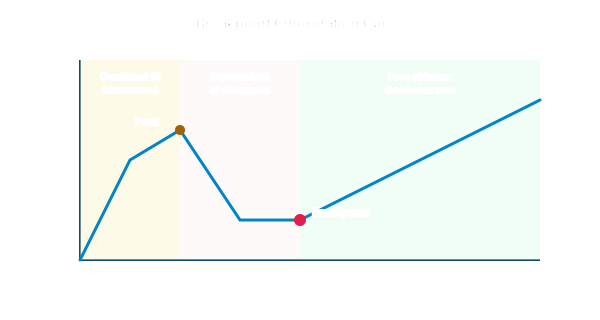
- Confusing "breakpoint" with "peak." The breakpoint is the minimum of the dose-residual curve, where chloramines have just been destroyed. The peak earlier on the curve is the maximum chloramine residual, not the breakpoint. See the breakpoint chlorination guide for the curve walked through in detail.
- Reading combined chlorine as a contamination indicator. Combined chlorine isn't a pathogen indicator. It just means you have ammonia in the water reacting with the dose.
What to know for the exam
Free vs combined questions show up in three flavors on the certification exam:
- Identification: "Which of the following is free chlorine?" with HOCl, OCl⁻, NH₂Cl, NHCl₂ as choices. (Free = HOCl + OCl⁻.)
- Operating choice: "Which residual would you expect in a system with a long detention time and high TTHM precursors?" (Chloramines.)
- DPD reading interpretation: "Plant reads 2.0 mg/L total chlorine and 0.3 mg/L free. What is the dominant species?" (Chloramines, combined is 1.7 mg/L.)
The disinfection practice test covers all three at every level. The breakpoint chlorination guide explains the chemistry under the hood, and the CT calculations guide covers how the residual reading drives compliance math.
Practice what you learned
You now know what free, combined, and total chlorine actually are, why your plant runs on one or the other, and how pH dramatically shifts what your residual reading is doing. The next step is reps. Take the free disinfection practice test, 50 questions with explanations, and pair it with the chemical dosage calculator for the math side.