Breakpoint Chlorination Explained: What the Curve Actually Means
Breakpoint chlorination is one of those topics where every textbook draws the same squiggly curve, labels it with words like "monochloramine" and "dichloramine," and expects you to nod along. Most operators learn to recognize the picture without ever really understanding what's happening in the water. That's a problem on the exam, breakpoint questions show up at every level, and a bigger problem when you have to optimize chloramine dosing or burn out a nitrifying main on the job. This guide unpacks the curve in plain English, with the math you need and the operating decisions it drives.
Key takeaways
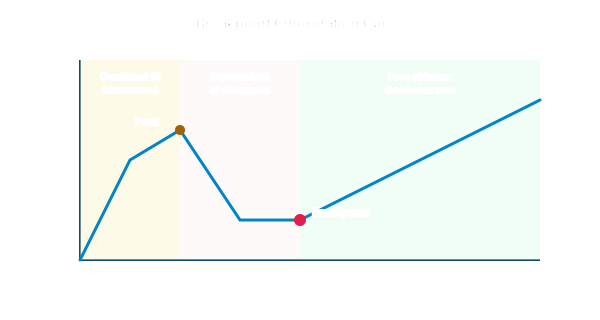
- The breakpoint curve plots chlorine residual on the Y axis against chlorine dose on the X axis. It is the picture of what happens chemically as you add more and more chlorine to water containing ammonia.
- Before the breakpoint, added chlorine reacts with ammonia to form chloramines (combined chlorine). At the breakpoint, those chloramines are destroyed. After the breakpoint, additional chlorine forms a free residual.
- The Cl₂:N mass ratio at the breakpoint is around 7.6:1, but operators usually run just past it.
- Chloraminated systems intentionally stop before the breakpoint to maintain monochloramine residual.
- Free-chlorine systems dose past the breakpoint to deliver free chlorine to the distribution system.
- Test what you've learned with the free disinfection practice test, 50 questions with explanations.
The chemistry, simplified
Three reactions matter. When you add chlorine (as Cl₂ gas, sodium hypochlorite, or calcium hypochlorite) to water, the first thing it does is hydrolyze:
Cl₂ + H₂O → HOCl + HCl
Hypochlorous acid (HOCl) is the active disinfecting form. In water above about pH 5, most of that HOCl is also in equilibrium with hypochlorite ion (OCl⁻). The sum of HOCl and OCl⁻ is what operators call free chlorine.
If the water contains ammonia, and most surface water and many groundwaters do, in trace amounts, the free chlorine reacts with it almost instantly:
HOCl + NH₃ → NH₂Cl + H₂O      (monochloramine forms first)
HOCl + NH₂Cl → NHCl₂ + H₂O   (dichloramine forms next)
HOCl + NHCl₂ → NCl₃ + H₂O    (trichloramine, or nitrogen trichloride)
The combined chlorines (NH₂Cl, NHCl₂, NCl₃) together are what operators call combined chlorine or just chloramines. Add enough chlorine and you eventually overwhelm the ammonia. Past that point, the chloramines themselves are destroyed by additional chlorine in a reaction that releases nitrogen gas:
2 NH₂Cl + HOCl → N₂↑ + 3 HCl + H₂O
Once the ammonia is gone, additional chlorine builds up as free chlorine. That moment is the breakpoint.
Walking through the breakpoint curve
The curve has three regions. Each one corresponds to a different chemical state of the water and a different operating implication.
Region 1, Combined chlorine rising. From zero dose up to about 5 mg/L Cl₂ per mg/L ammonia (as N), every milligram of chlorine you add forms a milligram of chloramines. Residual rises in lockstep with dose. The residual you measure on a DPD test will show as combined chlorine; almost no free chlorine is present. This is where chloraminated systems intentionally operate.
Region 2, Combined chlorine destruction. Past about Cl₂:N = 5:1, you've added enough chlorine to start destroying the chloramines themselves. Now adding more chlorine reduces total chlorine residual. The curve goes down. This is the dip. The minimum point, where nearly all chloramines have been oxidized away but no free residual yet exists, is the breakpoint, typically at a Cl₂:N mass ratio of about 7.6:1.
Region 3, Free chlorine rising. Past the breakpoint, ammonia is gone. Additional chlorine doesn't have anything to react with, so it accumulates as free residual. The curve goes back up linearly. Every milligram of chlorine added now produces a milligram of free chlorine residual.
The transition between these three regions is the picture in every operator textbook. The Y-axis value at the peak of region 1 is the maximum chloramine residual the water can hold. The X-axis value at the breakpoint tells you how much chlorine you need to dose to get past it.
How operators actually use the curve
Most operators never need to draw the curve. What they need to know is which region they want to operate in and how to get there.
Free-chlorine systems. Plants that disinfect with free chlorine dose past the breakpoint. The math is approximately Cl₂:N = 8:1 (just past breakpoint) plus enough additional chlorine to leave a target residual through distribution. If your finished water has 0.3 mg/L of ammonia (as N) and you want a 1.0 mg/L free chlorine residual at the plant, you need roughly: 0.3 × 8 = 2.4 mg/L to break through, plus 1.0 mg/L for residual = about 3.4 mg/L total dose. In practice, you raise dose gradually and watch the residual climb.
Chloraminated systems. Plants that chloraminate intentionally stop before the breakpoint. The target Cl₂:N mass ratio is 4–5:1, which keeps you firmly in region 1 with monochloramine as the dominant species. Below 3:1 the residual is too low; above 5:1 you start forming dichloramine and trichloramine, which taste and smell bad. The chemical dosage calculator handles the lbs/day math once you know the target dose and your plant flow.
The seasonal burn. Even chloraminated systems occasionally run a temporary "free chlorine burn", typically a few weeks in spring: to oxidize accumulated ammonia, destroy nitrifying biofilm, and re-establish residual at the far ends of the system. A burn is just the operator deliberately dosing past the breakpoint for a controlled period before returning to chloramination.
What the breakpoint tells you about your water
A breakpoint test isn't just an exam-prep exercise. It tells you three things about your raw water:
- How much ammonia is present. The breakpoint dose ÷ 7.6 gives you the ammonia concentration as N. If your breakpoint is 2.3 mg/L of chlorine, your water has roughly 0.3 mg/L of ammonia as N.
- How much chlorine demand the water has. The chlorine consumed before the breakpoint includes demand from organics, iron, manganese, sulfides, and other reductants on top of the chloramine formation. If theoretical breakpoint says 2.3 mg/L but you actually need 4 mg/L to hit free chlorine, the additional 1.7 mg/L is non-ammonia demand.
- Whether chloramination is feasible. If your raw water has so much ammonia that the breakpoint requires uneconomical chlorine doses, chloramination is the natural fit (you're already past the formation curve). If ammonia is negligible, free chlorine is the natural fit.
Common mistakes on breakpoint questions
These come up on exams and in operations conversations both. None of them are about math.
- Reading the Y-axis as dose instead of residual. The Y-axis on the curve is residual chlorine, not dose. The X-axis is dose. Dose goes up across the page; residual goes up and down.
- Calling the peak "the breakpoint." The breakpoint is the minimum of the curve, the point where chloramines have just been destroyed. The peak earlier in the curve is the maximum chloramine residual, not the breakpoint.
- Assuming chloramines are useless. Chloramines are weaker than free chlorine for primary disinfection (30–100× higher CT for Giardia), but they persist far longer in distribution and form fewer regulated DBPs. They're the right choice for systems with long detention times or high THM precursors.
- Forgetting that pH affects free chlorine speciation. At pH 7, free chlorine is about 75% HOCl (the strong form). At pH 8, it's about 25% HOCl. Higher pH dramatically reduces disinfection effectiveness even at the same residual.
- Treating the 7.6:1 ratio as exact. The actual breakpoint depends on water chemistry, temperature, pH, and contact time. Operators usually verify with bench tests or a profile of dose vs. residual instead of relying on the theoretical number.
- Skipping the contact time. Breakpoint takes time. At cold temperatures and short contact, you can dose past the theoretical breakpoint and still have residual chloramines hanging around. Allow at least 30 minutes of contact before reading the post-breakpoint residual.
- Confusing chloramines with chloramination. Chloramines form whenever chlorine and ammonia meet. Chloramination is an operational decision to intentionally form and maintain them. Free-chlorine systems still see brief chloramine formation upstream of the breakpoint.
When your numbers don't match the textbook
In the field, the curve never looks exactly like the picture. Iron and manganese consume chlorine before any ammonia gets involved. Natural organic matter shifts the breakpoint to a higher dose. Cold water slows every reaction. If your actual breakpoint dose is 50% higher than 7.6× the ammonia concentration, you almost certainly have unaccounted-for demand: start looking at iron, manganese, sulfides, or NOM.
That's also why pre-oxidation with potassium permanganate or pre-chlorination at the rapid mix is so common at conventional plants. By the time the water hits the disinfection contactor, most of the non-ammonia demand has already been satisfied, and your breakpoint dose drops back close to the theoretical value.
How to practice
Breakpoint questions on the certification exam come in two flavors. The first asks you to identify the curve and label its regions, pure recognition. The second asks you to interpret an operational scenario: "A plant operates at Cl₂:N = 4:1. Which dominant species is in the finished water?" or "If a plant raises its chlorine dose from 1.5 to 4.0 mg/L while ammonia stays at 0.4 mg/L, what happens to the residual?"
Both kinds of questions are on the free disinfection practice test, 50 questions with explanations on every one. The chemical feed practice test covers the dose calculations that go with it.
For deeper background, the EPA's Disinfection Profiling and Benchmarking Technical Guidance Manual under Stage 1 D/DBP includes worked examples of breakpoint chemistry in real plant conditions.
Practice what you learned
You now know what the breakpoint curve really shows, why operators choose to operate before or after it, and what trips most candidates up on the exam. The next step is reps. Run the free disinfection practice test for the chemistry, and when the math gets thick, the chemical dosage calculator will show you the formula step by step with your numbers plugged in.