Storage Tank Operations: Cycling, Water Age, and Why Tanks Go Stale
Every distribution operator has stood at the foot of a storage tank ladder and wondered what's actually happening inside. The tank looks the same from outside whether it's cycling beautifully or quietly turning into a nitrification reactor at the top. The difference between those two states is whether the operator is running the tank, fill-and-drain cycles, mixing, water age management, or letting the tank run itself.
This guide covers the operating choices that decide how a finished-water storage tank actually behaves: tank types, fill/drain cycle design, water age, stratification, and the nitrification risk that haunts chloraminated systems.
Key takeaways
- A storage tank serves three jobs: equalize demand (fill during low-demand night hours, drain during peak-demand mornings), provide fire-flow reserve, and provide emergency storage if treatment goes offline.
- The tank's job determines its size. Equalization storage is typically 25-35% of average daily demand; fire-flow reserve is whatever your local code requires (often 2,000 gpm × 2-4 hours).
- The single biggest operational variable is water age, how long water sits in the tank before being used. Long water age burns up chlorine residual and lets DBPs form. Very long water age in chloraminated systems triggers nitrification.
- Tanks stratify thermally, warm water rises, cold water settles. Stratified tanks act like two tanks stacked. The bottom layer empties first, the top layer sits and ages.
- Active mixing (fluidic mixers, mechanical mixers, or aggressive fill cycling) prevents stratification and keeps water age uniform.
- Practice with the distribution operator practice tests; see related concepts in the pressure zones guide and the free vs combined chlorine guide.
Tank types and what they're called
Distribution storage falls into a few categories that the exam treats as distinct vocabulary:
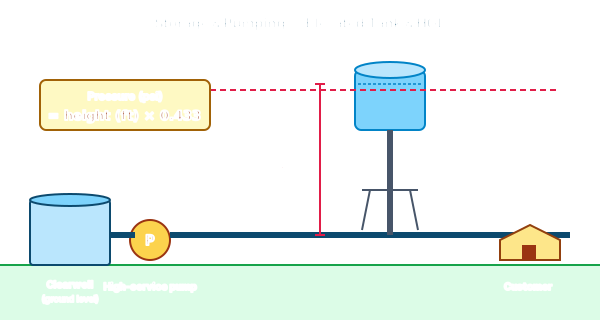
- Elevated tank (water tower), a steel tank on legs, with the bowl elevated 80-200 feet above the ground. Provides pressure by gravity. Common in flat areas where elevation has to be added artificially.
- Standpipe, a tall steel cylinder that sits on the ground. The bottom portion provides only volume (it sits below the local HGL); the top portion provides both volume and pressure (it sits above the HGL). Common where high natural ground elevation already provides pressure.
- Ground-level reservoir, a concrete or steel tank sitting at grade. Provides volume only, water has to be pumped into the distribution system. Common as raw-water storage and as finished-water storage on a hilltop.
- Hydropneumatic tank, a small pressurized vessel using compressed air to pressurize the water. Used in very small systems (well-and-tank arrangements for a single building or trailer park). Capacity is too small for meaningful equalization storage.
- Clearwell, the storage compartment at the treatment plant that holds finished water before it enters distribution. Often does double duty as chlorine contact volume (CT, see the CT calculations guide).
The exam will distinguish these clearly. Know that an elevated tank provides pressure and volume, a standpipe provides volume and partial pressure, and a hydropneumatic tank provides only short-term buffer for a single small service.
What the tank is sized for
Storage tank sizing comes from three independent calculations, and the controlling number is the largest of the three:
1. Equalization storage. The buffer that lets the treatment plant run at average daily demand while the distribution system swings between morning peak and overnight minimum. Most plants size this at 25-35% of average day demand. A 1 MGD plant needs 250,000-350,000 gallons of equalization storage.
2. Fire-flow reserve. The volume required to deliver the design fire flow for the design duration without dropping below 20 psi. Local fire codes set the design flow (often 2,000-3,500 gpm for residential, 4,000+ gpm for commercial) and duration (2-4 hours). A 2,500-gpm fire flow for 2 hours = 300,000 gallons of fire reserve, plus enough head for pressure.
3. Emergency/treatment outage storage. Volume to keep the system pressurized while the treatment plant is down for repairs or contamination response. Many systems target 1-2 days of average demand. A 1 MGD system targeting 1 day of emergency storage needs 1,000,000 gallons.
For most utilities, emergency storage is the controlling number, so total tank capacity often equals 1-2 days of average demand. The downside of huge tanks is high water age, which we'll get to.
Fill-and-drain cycling
A well-operated tank fills overnight (when treatment-plant output exceeds demand and pumps run cheap on off-peak electricity) and drains during morning peak. The shape of the level curve through 24 hours tells you whether cycling is working.
A typical healthy cycle: - Midnight to 5 AM: filling, level rises from 60% to 95% - 5 AM to 9 AM: morning peak, level drains from 95% to 70% - 9 AM to 6 PM: slow drain or hold steady at 70% - 6 PM to 10 PM: evening peak, level drops from 70% to 60% - 10 PM to midnight: fill resumes
That curve cycles the tank, exchanges its volume daily, which keeps water age low. A tank that fills overnight only enough to make up for the small overnight demand, and holds 95% for days, has terrible water age and will eventually have chlorine residual problems.
Operator levers for cycling:
- Setpoints, the tank fills when level drops below the "pump on" elevation and stops when it reaches "pump off." Setting the band narrow (say, 90% on, 95% off) limits cycling. Setting it wide (60% on, 95% off) forces good cycling.
- Time-of-day control, schedule pumps to run only during off-peak electricity hours, forcing the tank to drop substantially before the next refill window.
- Production rate, running the treatment plant at low rate slows refill and forces deeper cycling. Running at peak rate keeps the tank topped off and water age climbs.
The most common operator mistake is targeting a high-level setpoint (95-100%) all the time for fire-flow comfort. The result is a tank that barely cycles, and water at the top of the tank that's been sitting there since the spring rainfall changed the source-water character.
Water age and why it matters
Water age is the time between when water leaves the treatment plant and when it gets used. In a tank, water age depends on the cycling pattern, the tank's geometry, and whether it's stratified.
A well-cycled tank exchanges its full volume daily, giving an average water age inside the tank of about 12 hours. A tank that cycles only 10% per day has water sitting for 10 days on average, and the topmost layer for much longer.
What goes wrong as water ages:
-
Chlorine residual decays. Free chlorine dissipates over hours; chloramines decay over days. By the time average water age exceeds 5-7 days, residual is often unmeasurable at the tank bottom and in zero ppm at the top. Operators then have to chase residual by raising the plant dose, which raises DBP formation downstream.
-
DBPs form. TTHM and HAA5 formation continues to climb with water age. Stage 2 D/DBPR violations show up first at the system's longest water-age site, usually the tank's effluent or a dead-end downstream from it. See the DBP guide for the full picture.
-
Nitrification risk climbs (chloramine systems). Chloramine slowly releases ammonia as it decays. Nitrifying bacteria in the tank convert that ammonia to nitrite and nitrate, which destroys the remaining chloramine and creates a self-sustaining nitrification loop. Most systems see nitrite spikes when water age in the tank exceeds about 2 weeks.
-
Biological growth. Lower disinfectant residual means biofilm has more room to grow on the tank walls and roof. Eventually that biofilm sheds and shows up as taste-and-odor complaints downstream.
-
Temperature stratification worsens. Warmer surface water stays at the top, ages quickly, and never mixes with the cooler bottom. By summer's end, the top 3 feet of a stratified tank can be days older than the bottom.
Stratification: the slow killer
Storage tanks are big, calm vessels. The inlet typically dumps incoming water in at the side or bottom; the outlet pulls from the bottom. If incoming water is warmer than the tank water, it rises. If it's cooler, it sinks. Either way, the tank can develop horizontal layers that don't mix.
In a stratified tank, the outlet pulls only from one layer (usually the bottom), and the other layers just sit. They're not part of the daily cycle. Their water age is the time since the tank was last fully mixed, which might be weeks or months.
Detecting stratification: Drop a sample tube down through the tank hatch on a calm day and measure temperature, chlorine residual, and pH at 2-foot intervals. A well-mixed tank will read the same at all depths. A stratified tank will show a clear thermal layer (often 1-3°F change across a layer boundary), with chlorine residual dropping in the older layers.
Fixes:
- Active mixing. Mechanical mixers (impeller mounted on the tank floor, motor outside) or fluidic mixers (a nozzle that pumps water in a recirculating jet) destroy stratification and produce uniform water age. The capital cost is modest and the ROI is fast in chloraminated systems.
- Inlet/outlet geometry. Separating the inlet from the outlet (inlet at the bottom of one side, outlet at the bottom of the opposite side) forces a flow path through the tank instead of letting incoming water pool near the outlet.
- Bypass piping. Some plants pipe a small bypass that draws from the tank top during low-demand periods, dosing it back into the inlet line, forcing the top layer to participate in cycling.
- Aggressive cycling. Wide setpoint bands and full daily cycling are the cheapest fix. The bigger the daily water exchange, the less stratification can persist.
Nitrification: the chloramine-system nightmare
Chloramine is the secondary disinfectant of choice for systems that need to control DBPs while maintaining residual in long distribution systems. The trade-off is that chloramines hydrolyze slowly back to ammonia, and nitrifying bacteria love ammonia.
A nitrification episode looks like this:
- Tank water age climbs above 10-14 days during a cool, low-demand season.
- Nitrifiers (Nitrosomonas, Nitrobacter) colonize the tank walls and biofilm.
- They begin converting the trace ammonia from chloramine decay into nitrite.
- Nitrite reduces the chloramine, destroying residual.
- With residual gone, more nitrifiers grow, accelerating the loop.
- Eventually heterotrophic bacteria explode too, and HPC counts spike.
The detection signals operators watch for: - Chloramine residual dropping faster than expected - Total ammonia climbing - Nitrite appearing in tank samples (above 0.05 mg/L is concerning) - pH dropping (nitrification is acid-producing) - HPC counts climbing
The fixes, from easy to expensive: - Reduce tank water age via cycling and mixing. - Increase chloramine residual at the plant. - Flush the affected portion of the system. - Break-chlorinate (temporarily switch from chloramine to free chlorine for several weeks to oxidize the biofilm). See the free vs combined chlorine guide. - Drain, clean, and disinfect the tank.
Most chloramine systems have a written nitrification action plan with tiered triggers. Class B and A exams test conceptually whether operators know what's happening, what to watch for, and what the response sequence looks like.
Worked example: a tank cycling check
A 500,000-gallon elevated tank serves a town with average daily demand of 300,000 gpd. Tank inlet is at the bottom; outlet is at the bottom; level varies between 88% (440,000 gal) and 95% (475,000 gal) on a typical day.
Daily volume exchange:
475,000 − 440,000 = 35,000 gallons
Daily exchange as % of tank volume:
35,000 ÷ 500,000 × 100 = 7%
That's a poorly cycling tank. The water in the top 85% of the tank effectively doesn't move. Water age in the static portion is on the order of:
500,000 / 300,000 = 1.67 days for full exchange at total demand
But only 7% exchanges daily, so most water sits for ~14 days
The fix isn't building more tank, it's setting wider operating bands so the tank actually cycles. Recommend new setpoints of 60% (300,000 gal) "pump on" and 95% (475,000 gal) "pump off." Daily exchange goes from 7% to 35%, and average water age drops from ~14 days to ~3 days.
Common exam pitfalls
Treating tank capacity as the relevant number. Tank capacity sets fire-flow reserve. Tank cycling sets water age. A 5 MG tank that doesn't cycle is worse than a 500,000-gal tank that does.
Forgetting that nitrification is a chloramine-only problem. Free-chlorine systems don't release ammonia, so nitrification isn't a risk. The cost of free chlorine is faster residual decay; the cost of chloramine is nitrification risk.
Assuming all tanks of the same volume have the same water age. Inlet/outlet geometry, mixing systems, and operating setpoints all matter. Two identical tanks operating differently can have very different water ages.
Mixing up the three storage purposes. Equalization storage buffers daily demand. Fire-flow reserve handles peak emergencies. Emergency storage covers treatment outages. They're additive, not interchangeable.
Quick reference
- Equalization storage: 25-35% of average daily demand
- Fire-flow reserve: per local code (typically 2,000-3,500 gpm × 2-4 hours)
- Emergency storage: 1-2 days of average demand
- Healthy daily cycling: 25-40% of tank volume exchanged daily
- Nitrification onset: chloramine systems, typically when tank water age exceeds 10-14 days
- Nitrite alarm threshold: typically 0.05 mg/L
Practice and next steps
- Distribution operator practice tests: Grade 1–4, covering storage, pressure, and flow.
- Pressure zones and the hydraulic grade line: what tank elevation does for pressure.
- Distribution system flushing: what to do about water-age problems downstream of the tank.
- Free vs combined chlorine: chloramine chemistry that drives nitrification risk.
- Disinfection byproducts explained: DBPs that form at long water age.
- Chemical dosage calculator: for tank disinfection after cleaning.
Storage tanks are the slowest part of the water system. Every other process completes in hours. Tanks measure their cycle time in days, and they punish operators who forget to manage what's happening in them.