Water Distribution Pipe: Materials & Joint Types
Most of a water system is buried and out of sight, so it's easy to forget that the whole thing is just pipe and the joints between the pipe. But when a main breaks at 2 a.m., or you're tapping a line for a new service, or you're chasing a mystery leak, knowing what's in the ground, and how it's connected, is the difference between a clean repair and a long night. Here's the operator's field guide to distribution pipe materials and the joints that hold them together.
Key takeaways
- The three workhorse materials in modern distribution are ductile iron (DIP), PVC, and HDPE: plus legacy cast iron, asbestos-cement, steel, and concrete you'll still dig up.
- The most common buried joint is the push-on (bell-and-spigot) joint, a rubber gasket compressed as the spigot slides into the bell. Fast, flexible, and the default for DIP and PVC.
- Mechanical joints (MJ) bolt a gland to compress the gasket: common at fittings, valves, and hydrants. Flanged joints bolt two faces together for above-ground and plant piping.
- At bends, tees, dead ends, and valves, internal pressure pushes the pipe apart. You hold it with thrust blocks or restrained joints.
- HDPE is different: its lengths are heat-fused into one continuous, leak-free, fully restrained pipe.
- Drill distribution concepts on the water distribution practice tests and pair this with maintaining water quality in the distribution system.
Pipe materials you'll find in the ground
No single material wins everywhere; each is a trade-off of cost, strength, corrosion resistance, and how it's joined.
| Material | Where it's used | Strengths | Watch-outs |
|---|---|---|---|
| Ductile iron (DIP) | Mains of all sizes; the municipal mainstay | Very strong, high-pressure capable, long service life (100+ years when properly lined/coated) | Corrodes in aggressive soils: needs cement-mortar lining and polyethylene encasement |
| PVC (AWWA C900) | Very common distribution mains, especially mid-size | Inexpensive, corrosion-proof, smooth bore | Rigid and can be brittle; sensitive to UV, cold, over-deflection, and improper bedding |
| HDPE (AWWA C906) | Trenchless installs, river crossings, rural and urban mains | Corrosion-proof, flexible, fused joints are leak-free and fully restrained | Requires fusion equipment and trained crews; different repair approach |
| Steel | Large transmission mains | Very strong in tension, handles high pressure | Corrosion-prone; needs coatings and cathodic protection |
| Prestressed concrete (PCCP) | Large-diameter transmission | Strong, rigid, large sizes | Catastrophic-failure history; wire-break monitoring |
| Cast iron (legacy) | Old mains still in service | Lasted a century in many systems | Brittle, breaks in cold/ground movement; being replaced |
| Asbestos-cement (AC) (legacy) | Mid-20th-century mains | Corrosion-resistant | Handling/cutting is a health hazard, follow AC pipe safety rules |
| Copper / PE | Service lines (main to meter) | Reliable small-diameter service | Copper can corrode in aggressive water; dissimilar-metal connections need care |
The practical takeaway: modern new mains are usually ductile iron, PVC, or HDPE, but your system is a patchwork of decades of choices, and a repair clamp or fitting has to match what's actually there.
Joint types: how the pipe connects
This is where a lot of operator know-how lives, because the joint is usually where systems leak and where thrust forces try to pull the line apart.
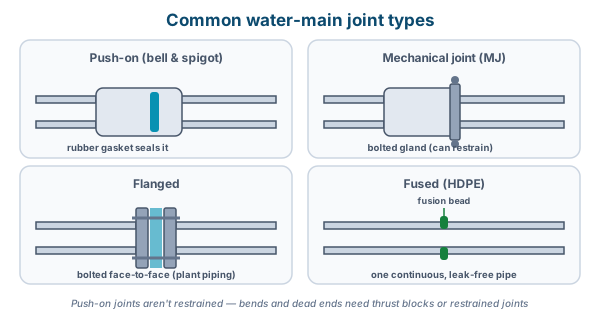
Push-on (bell-and-spigot) joint
The most common buried joint. One end of the pipe is belled; the other (spigot) end is beveled. A rubber gasket seats inside the bell, and the spigot is pushed through it, compressing the gasket into a watertight seal (AWWA C111 gaskets). It's fast, allows a few degrees of deflection for gentle curves, and is the default for ductile iron and PVC mains.
Key point: a standard push-on joint is not restrained, internal pressure can push the spigot back out of the bell. That's fine on a straight run (the soil friction and the next joint hold it), but it's why bends and ends need thrust restraint.
Mechanical joint (MJ)
An MJ uses a bolted gland (follower ring) that squeezes the gasket into the bell as you tighten the bolts. It's the go-to for fittings, valves, hydrants, and tie-ins because it assembles in tight spots and can be fitted with restraint glands (wedge-action retainers, often called by the brand "Megalug") to lock the joint against thrust.
Flanged joint
Two machined flanges bolted face-to-face with a gasket between them. Rigid and easily taken apart, so it's used for above-ground and in-plant piping, pump connections, and meter/valve assemblies, not for buried mains, because it can't deflect with ground movement.
Restrained joints
Where you can't or don't want a thrust block, restrained-joint systems lock the bell and spigot together: either proprietary boltless designs with internal locking rings, or retainer glands added to push-on/MJ joints. They carry the thrust force through the pipe itself.
Fused joints (HDPE)
HDPE doesn't use gaskets. Its lengths are joined by heat fusion, butt fusion (the pipe ends are heated and pressed together) or electrofusion (a coupling with an embedded heating coil), plus saddle fusion for service taps. The result is a single continuous pipe with no gaskets to fail; the joints are as strong as the pipe and inherently restrained. To tie HDPE into iron or PVC, crews use MJ adapters or flange/transition fittings.
Service-line joints
On the small pipe from the main to the customer's meter, you'll see compression fittings, flared joints, and soldered (sweated) copper connections, plus corporation and curb stops. Joining dissimilar metals (copper to galvanized, for example) invites galvanic corrosion, so dielectric fittings matter.
Why joints and thrust go together
Any time water under pressure changes direction or stops, at a bend, tee, reducer, dead end, or closed valve, it pushes outward with real force. On unrestrained push-on joints, that force tries to blow the joint apart. Operators counter it two ways:
- Thrust blocks, poured concrete that transfers the force into undisturbed soil behind the fitting.
- Restrained joints / retainer glands, locking the joints so the pipe resists the thrust itself.
Get this wrong and you get blown joints and repeat main breaks at the same fitting. (For the pressure side of this, see pressure zones and the hydraulic grade line.)
What operators actually watch
- Leaking joints. Gaskets roll, pinch, or dry out, and bolts on MJ/flanged joints loosen or corrode. A weeping joint is a small problem now and a washout later.
- The right repair part. A repair clamp, coupling, or fitting has to match the pipe's true outside diameter and material: DIP, AC, PVC, and cast iron of the "same" nominal size don't all measure the same.
- Corrosion. Bare iron in aggressive soil, dissimilar-metal service connections, and failing coatings drive leaks. Polyethylene encasement and cathodic protection are the defenses.
- Disturbed restraint. After any excavation near a bend or hydrant, confirm thrust blocks or restraints went back in, an unrestrained bend is a time bomb.
- Asbestos-cement safety. Cutting or breaking AC pipe releases fibers; follow your utility's AC handling procedures.
Practice it
Pipe, joints, and thrust restraint show up across distribution exams, especially at the higher grades. Drill them on the water distribution practice tests, and pair this guide with maintaining water quality in the distribution system, pressure zones and the hydraulic grade line, and distribution system flushing. For the hydraulics math, see the distribution operator math formulas.
This guide is a free study aid covering general distribution-system practice. Materials, standards, and repair methods vary by utility and era of construction: always follow your system's specifications, AWWA standards, and your supervisor's direction, and observe all safety procedures (especially for asbestos-cement pipe). Reviewed June 2026.