Types of Water Meters: An Operator's Guide
A water meter looks like a simple part, but it does two big jobs: it measures what customers owe, and it's one of your best tools for finding water you're losing. Pick the wrong meter, or let an old one slow down, and the utility quietly gives water away. Here's how the main meter types work, where each one belongs, and what operators watch.
Key takeaways
- Meters fall into two families: displacement (a part physically moves with each unit of water) and velocity (water spins a rotor and speed is converted to flow).
- Positive displacement (PD) meters, oscillating piston or nutating disc, are the standard for homes and small services; they're very accurate at the low flows houses actually use.
- Multi-jet and turbine meters handle higher, steadier flows; turbines are great at high flow but weak at low flow.
- Compound meters combine a turbine (high flow) and a PD/multi-jet (low flow) for places with a wide flow swing: apartments, schools, commercial buildings.
- Electromagnetic and ultrasonic meters have no moving parts: accurate, low-maintenance, common on large mains and at plants, and the basis of most modern smart meters.
- The big operator lesson: meters wear and slow down, under-register, and create "apparent" (non-revenue) water loss. Right-size them and test them.
- Drill the distribution side on the water distribution practice tests, and pair this with distribution operator math.
Two ways to measure water
Almost every meter works one of two ways:
- Displacement, water fills and empties a known chamber over and over; counting the cycles counts the volume. Excellent at low flow, which is why it dominates residential metering.
- Velocity: moving water spins a rotor (jet or turbine), and the rotation speed is converted to a flow rate, then totalized. Better suited to larger, steadier flows.
Get that distinction and the rest of the meter world falls into place.
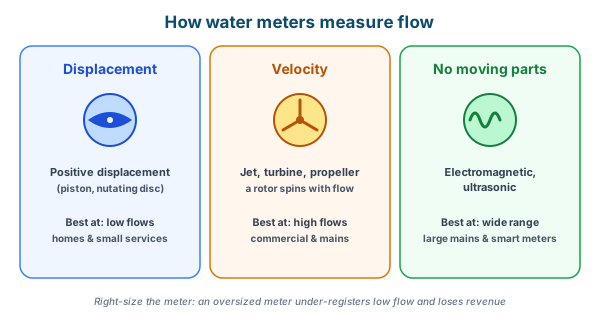
The meter types
Positive displacement (PD)
The workhorse of residential and small commercial service. Inside is an oscillating piston or nutating disc that physically moves once per known volume of water. PD meters are very accurate at the low flows typical of a house (a trickling faucet, a running toilet), exactly where you want accuracy for billing. They don't like dirty water, which can jam the moving element.
Single-jet and multi-jet
Velocity meters where one or several jets of water strike an impeller. Multi-jet meters spread the load across multiple ports, which improves accuracy and wear over single-jet. They're common on mid-size commercial services and handle a broad flow range well, though grit and debris are still an enemy of the moving parts.
Turbine
Water spins an axial turbine rotor; rotation is proportional to velocity. Turbines shine at high, continuous flow (large commercial, irrigation, industrial) but are less accurate at low flow, a slow leak or trickle can slip through under-registered. That weakness is exactly what the compound meter solves.
Compound
A compound meter is really two meters in one body with an automatic changeover valve: a turbine for high flow and a PD or multi-jet for low flow. When demand is high, water runs through the turbine; when it drops, the valve routes it through the small meter so low flows still register accurately. Ideal for buildings with a wide flow swing, apartment complexes, hospitals, schools, where one technology alone would miss part of the range.
Electromagnetic ("mag")
A mag meter has no moving parts. It applies a magnetic field and measures the tiny voltage produced as water (a conductor) moves through it, that voltage is proportional to velocity. Mag meters are accurate across a wide range, low-maintenance, and unbothered by grit, which makes them popular for large mains, treatment-plant flows, and raw water. They need electrically conductive water and a power source.
Ultrasonic
A static, no-moving-parts meter that uses transit-time technology: transducers send sound pulses upstream and downstream, and the tiny difference in travel time gives the velocity. Ultrasonic meters are accurate over a very wide range, hold calibration well, and run on batteries, which is why they're increasingly the choice for modern smart-metering at every size.
Propeller
A velocity meter with a propeller set in the flow, used mainly on large-diameter mains and raw-water/irrigation lines with high, steady flow.
Reading the meter: AMR and AMI
How the meter is read is a separate question from how it measures:
- AMR (Automatic Meter Reading), a reader drives or walks by and collects the reading wirelessly. No more lifting every lid.
- AMI (Advanced Metering Infrastructure), meters report continuously over a fixed network. AMI is the big leak-finding upgrade: it flags continuous flow (a sign of a customer-side leak), reverse flow, and tampering, and gives you near-real-time district data.
Why meter accuracy is an operator issue
Here's the part that matters even if you never install a meter: meters lose accuracy as they age, and they almost always slow down, under-registering. Under-registration means the customer used water you never billed for. Multiply that across thousands of aging meters and it becomes a major slice of non-revenue water, specifically the "apparent loss" category (metering and billing error), as opposed to "real loss" (physical leaks).
A few practical consequences:
- Right-size the meter. An oversized meter spends most of its life in the low-flow range it measures worst, so it under-registers and loses revenue. Size to the actual flow, not the pipe.
- Test and replace on a schedule. AWWA's meter guidance (the M6 manual and the C700-series meter standards) lays out accuracy limits and testing, large meters get tested more often because each one carries so much volume.
- Pair meters with a water audit. Meter accuracy is one input to an AWWA water-balance/audit; tightening it is often cheaper "found water" than chasing every leak.
What operators watch
- Stopped or stuck meters, zero consumption on an occupied service is a red flag.
- Continuous flow / leak alarms on AMR-AMI systems, the fastest way to catch customer-side leaks.
- Dirty water and grit chewing up moving-element meters; strainers help on jet/turbine installs.
- Large-meter accuracy, a single under-registering compound or turbine meter on a big account can dwarf hundreds of house meters.
- Backflow / reverse flow at the meter, which can signal cross-connection risk.
Practice it
Metering, water loss, and distribution math show up on distribution exams. Drill them on the water distribution practice tests, and pair this with distribution operator math, maintaining water quality in the distribution system, and the companion guide on distribution pipe materials and joints.
This guide is a free study aid covering general metering practice. Meter selection, sizing, accuracy limits, and testing intervals vary by utility: follow AWWA standards (the M6 manual and C700-series), your system's specifications, and your supervisor's direction. Reviewed June 2026.