Filter Loading Rates and Backwashing: The Math You Need on Exam Day
Coagulation, flocculation, and sedimentation get most of the spotlight in water treatment training. But the filter is where small mistakes show up fast. Push the loading rate too high and the floc breaks through. Run the backwash too gentle and the bed fouls; too aggressive and the media leaves with the wash water. Every exam from Class C up asks loading-rate and backwash-rate math, and every plant runs that math in practice every shift.
This guide covers the four numbers every filter operator needs to know cold: filter loading rate, filter run time, backwash rate, and bed expansion.
Key takeaways
- Filter loading rate = flow (gpm) ÷ filter surface area (sq ft). Conventional rapid sand filters run 2 gpm/sq ft; dual-media filters run 4–6 gpm/sq ft; high-rate filters run up to 8 gpm/sq ft.
- Filter run time = water produced (gal) between backwashes ÷ flow (gpm). Typical conventional run is 24–72 hours; high-rate or stressed plants run shorter.
- Backwash rate = wash flow (gpm) ÷ filter surface area (sq ft). Sand filters need 15–20 gpm/sq ft; anthracite filters need 12–15 gpm/sq ft.
- Bed expansion = (expanded depth − settled depth) ÷ settled depth × 100. Target 25–50% expansion to fluidize media and shear off captured floc.
- Loading rate, backwash rate, and bed expansion all change with water temperature, cold water is more viscous and needs lower rates.
- Practice with the filtration practice test and the math practice test; cross-check your work with the chemical dosage calculator.
What a granular media filter does
The filter is the second-to-last barrier before disinfection. Settled water leaves the sedimentation basin at 0.5–2 NTU, depending on the coagulation/flocculation step. The filter has to drop that to under 0.3 NTU 95% of the time (Long Term 2 Enhanced Surface Water Treatment Rule), and most plants target 0.1 NTU or lower as an internal goal because finished turbidity is the primary indicator of barrier integrity.
Granular media filters trap floc by a combination of mechanisms: straining at the surface, settling onto media grains inside the bed, and adhesion to the coated media surface. The floc that gets through coagulation/flocculation and sedimentation has to be "filterable", that's what the upstream chemistry is optimizing for. If coagulation is off, no amount of filter tweaking will produce clean finished water.
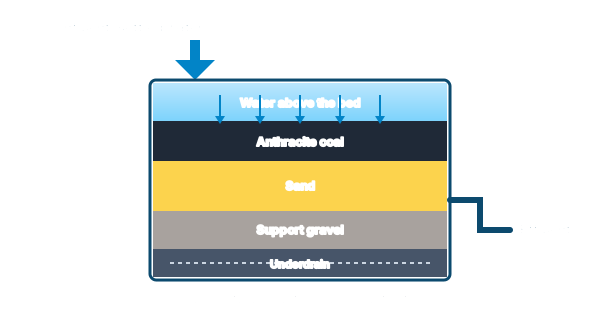
Filters come in two main configurations: rapid sand (single-media, all silica sand) and dual-media (anthracite on top, sand below). Dual-media is the modern standard because it uses depth of bed more effectively: large anthracite grains catch most of the floc in the upper layer, and finer sand polishes whatever gets through. A few high-rate plants run multimedia (anthracite over sand over garnet) for even better depth filtration.
Filter loading rate: the first number
Loading rate is how much water per minute is passing through each square foot of filter area. The formula:
Filter loading rate (gpm/sq ft) = Flow (gpm) ÷ Filter surface area (sq ft)
A 4 MGD plant with four equal filters, each 12 ft × 20 ft, runs at a per-filter flow of:
4 MGD × 1,000,000 gal/MGD ÷ 1,440 min/day ÷ 4 filters
   = 4,000,000 ÷ 1,440 ÷ 4
   = 694 gpm per filter
And each filter has 12 × 20 = 240 sq ft. So loading rate is:
694 gpm ÷ 240 sq ft = 2.9 gpm/sq ft
That number tells you the filter is running comfortably for a dual-media filter (designed for 4–6 gpm/sq ft) but slightly above design for a rapid sand filter (designed for 2 gpm/sq ft). Knowing your design loading rate is the first thing every shift starts with.
Typical loading rates by filter type:
- Rapid sand (single-media): 2 gpm/sq ft
- Dual-media (anthracite/sand): 4–6 gpm/sq ft
- Multimedia or high-rate: 6–8 gpm/sq ft
- Slow sand: 0.05–0.13 gpm/sq ft (very different process)
What happens when you push loading rate up
Higher loading rate means higher velocity through the bed, which means three things:
- Less contact time for adhesion and settling onto media. Floc has fewer chances to stick before it exits the bottom.
- Higher pressure drop across the bed at the same level of floc accumulation. Head loss climbs faster. Filter runs get shorter.
- Shear that can break captured floc off the media and push it through. This is the "breakthrough" problem, turbidity climbs sharply near the end of a filter run as floc tears off.
Plants get tempted to push loading rate when demand exceeds design, say, summer peak demand on a plant designed for winter average. But pushing loading rate past design risks turbidity violations. The right answer to a demand problem is more filters, not faster filters.
Filter run time
Filter run time is the hours between backwashes. The formula:
Run time (hr) = Volume filtered (gal) ÷ Flow (gph)
Run time isn't really an operator-controlled number, it falls out of how fast head loss builds up and how fast turbidity climbs. Most filters end a run on one of three triggers, whichever comes first:
- Head loss limit, typically 8–10 ft of water column. The pressure drop across the dirty bed exceeds the available head, and flow can't be maintained without negative pressure (which causes air binding).
- Turbidity limit: effluent turbidity climbs above the alarm setpoint (typically 0.3 NTU per LT2ESWTR, or 0.1 NTU as an internal target).
- Time limit: many plants enforce a 24, 48, or 72-hour maximum run regardless of head loss, to keep biofilm from building inside the bed.
A typical conventional plant filter runs 30–48 hours. A plant fighting an algal bloom or high-turbidity event might be cycling filters every 8 hours.
Unit filter run volume (UFRV) is a related performance metric. UFRV = gallons filtered per square foot of filter area in one run. A well-operated dual-media filter delivers 5,000–10,000 gal/sq ft per run. UFRV is sensitive to coagulation quality, bad coag chemistry shows up as low UFRV before it shows up as elevated effluent turbidity.
Backwashing: what it does and why the math matters
Backwashing reverses the flow through the filter at high velocity to fluidize the media, shear off captured floc, and carry that floc out the wash troughs. Done right, it restores the bed to a clean baseline. Done wrong, it either leaves dirt behind or carries media out with the floc.
The backwash rate formula is the same shape as the loading rate formula:
Backwash rate (gpm/sq ft) = Wash flow (gpm) ÷ Filter surface area (sq ft)
A 240-sq-ft filter that backwashes at 4,800 gpm runs at:
4,800 gpm ÷ 240 sq ft = 20 gpm/sq ft
That's at the top of the range for sand filters and is too aggressive for an anthracite top layer.
Typical backwash rates:
- Rapid sand: 15–20 gpm/sq ft
- Dual-media (anthracite top): 12–15 gpm/sq ft, anthracite is less dense than sand and floats out at high rates.
- High-rate filters: 18–25 gpm/sq ft, often combined with air scour first.
The right backwash rate is the one that gives the right bed expansion.
Bed expansion: the visual proof the backwash is working
When the filter is backwashing at the right rate, the media bed fluidizes: the grains separate, lift, and move enough to shear off the captured floc. The bed gets visibly taller. Too little expansion and the bed doesn't separate and floc stays bound. Too much expansion and media gets carried over the wash troughs.
Bed expansion is the percent increase in bed depth during backwash compared to the settled bed depth:
Bed expansion (%) = (Expanded depth − Settled depth) ÷ Settled depth × 100
A 30-inch settled bed that expands to 40 inches during backwash:
(40 − 30) ÷ 30 × 100 = 33% expansion
Target range is 25–50% expansion. Below 20% the bed isn't fluidizing enough; above 60% you're losing media. Operators check expansion visually: most filters have a sight glass on the side, or operators mark expanded bed height on the filter wall during a controlled backwash.
Temperature changes everything
Cold water is more viscous, which means it pushes media more aggressively at the same volumetric flow rate. Winter backwash needs a lower flow rate than summer backwash to produce the same bed expansion. The rule of thumb:
- Cold water (under 5°C): reduce backwash rate by ~25% versus summer rate.
- Warm water (over 20°C): increase backwash rate by ~15% versus winter rate to achieve same expansion.
Plants that don't seasonally adjust backwash rate either lose media in winter (bed lifts too much in cold viscous water) or under-clean in summer (warm water doesn't fluidize at the lower winter rate). The Class A exam loves to ask about this.
Air scour and surface wash
Some filters can't be cleaned by water backwash alone. Heavily fouled filters, or filters with mudball formation, need mechanical assistance:
Air scour, air is injected through the underdrain before or during the wash to physically scrub the grains. Air scour rates are typically 3–5 scfm per square foot. Most high-rate plants run air scour for 1–3 minutes before initiating water backwash, then sometimes simultaneously for another 2 minutes.
Surface wash, rotating arms above the bed spray water across the top of the media during the first part of backwash. The shear breaks up the floc cake on the surface so the water backwash can carry it out. Common on older sand filter installations.
Without one of these, badly fouled filters develop "mudballs": clumps of bound floc, media, and biofilm that settle to the bottom of the bed and never fully wash out. Mudballs progress to "boils", channels through the bed that short-circuit flow and produce high turbidity at low head loss. The fix is one painful manual cleaning and a serious look at why backwash wasn't doing its job.
Worked example: a full filter math problem
A plant runs four filters, each 14 ft × 24 ft, treating 6 MGD evenly distributed across all four. Each filter has 18 inches of anthracite over 12 inches of sand, settled depth 30 inches. The plant backwashes one filter at a time at 4,200 gpm and observes expansion to 39 inches.
Filter surface area: 14 × 24 = 336 sq ft each
Per-filter flow during normal operation: - 6,000,000 gal/day ÷ 1,440 min/day = 4,167 gpm total - 4,167 ÷ 4 filters = 1,042 gpm each
Loading rate: - 1,042 ÷ 336 = 3.1 gpm/sq ft (comfortable for dual-media)
Backwash rate: - 4,200 ÷ 336 = 12.5 gpm/sq ft (appropriate for anthracite top)
Bed expansion: - (39 − 30) ÷ 30 × 100 = 30% (in the target 25–50% range)
Everything checks out. This is exactly the calculation pattern the exam asks about.
Common operator and exam mistakes
Confusing loading rate with backwash rate. They use the same units (gpm/sq ft) but different flow numbers. Loading rate is forward flow during production; backwash rate is reverse flow during washing.
Using filter media area instead of plan area. Both formulas use the plan surface area of the filter, the horizontal footprint, not the surface area of the media grains.
Forgetting that dual-media filters can't take the same backwash rate as sand-only filters. Anthracite is less dense than sand and floats out at high rates. A 20 gpm/sq ft backwash on a dual-media filter sends anthracite out the trough.
Ignoring temperature. Operators new to a plant often use last summer's backwash rate in February and lose half their freeboard worth of media to the trough.
Treating UFRV as the only filter performance metric. UFRV is one indicator. Effluent turbidity profile through the run, head loss curve, and post-backwash water quality all matter.
Practice and next steps
- Free filtration practice test: 50 questions on filter operation, backwashing, media, and breakthrough.
- Free water operator math practice test: broader math practice covering loading rates, dosage, and detention time.
- Jar testing explained: the upstream step that decides whether your filter will run clean.
- Coagulants compared: coagulant chemistry that drives filter performance.
- SDI in practice: the membrane-filtration equivalent of these granular-filter loading concepts.
- Chemical dosage calculator: works out filter-aid polymer dose if you're using one.
Loading rate and backwash rate are two numbers every filter operator owns. Get them right and the filter does its job invisibly. Get them wrong and the trouble shows up in the very next chlorinated water sample.