Silt Density Index (SDI): What Your 0.45 µm Membrane Filter Is Telling You
Silt Density Index, SDI, is the single number that determines whether your reverse-osmosis or nanofiltration train is going to last six months or six years. Every membrane manufacturer publishes an SDI specification on their datasheet, and every membrane that fouls early in its life fouled because the SDI was too high. This guide walks through what the test actually measures, how to run it correctly, and how to interpret the result in operating terms, not just textbook ones.
Key takeaways
- SDI is a timed plugging test: feed water at 30 psi through a 0.45 µm filter for 15 minutes, then compare the start and end flow rates.
- The result is reported as SDI₁₅ (also written SDI 15), in units of % per minute.
- SDI < 3 is feed-ready for most spiral-wound RO membranes. SDI < 5 is the absolute upper limit on most datasheets. SDI > 5 means pretreatment is failing and the membrane will foul fast.
- SDI is not the same as turbidity. Two waters with the same NTU can have wildly different SDI.
- Use the free SDI calculator to compute SDI₁₅ from your bench-test times: punch in t₁, t₂, and total test time, and it spits out SDI₁₅ instantly.
- Drill the membrane-related questions with the free membrane filtration practice test and the sampling practice test.
What SDI actually measures
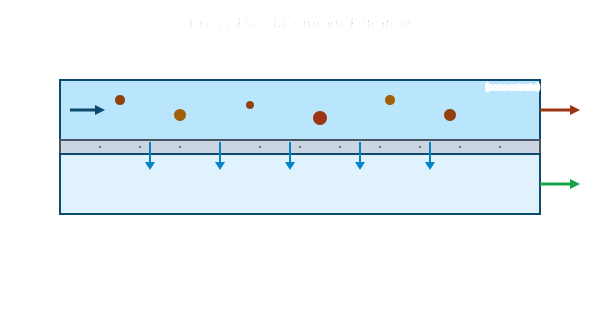
SDI measures the rate at which a 0.45 µm membrane plugs up when you push your feed water through it at a constant pressure. The math is straightforward:
SDI₁₅ = (1 − t₁/t₂) × 100 ÷ T
Where:
- t₁ = time (in seconds) to collect the first 500 mL of filtrate, measured at the start of the test
- t₂ = time (in seconds) to collect another 500 mL of filtrate, measured at the end of the test
- T = total elapsed time of the test in minutes (almost always 15)
So if it took 30 seconds to collect the first 500 mL, and 15 minutes later it takes 60 seconds to collect another 500 mL, SDI₁₅ = (1 − 30/60) × 100 ÷ 15 = 3.33.
The bigger the gap between t₁ and t₂, the more the filter has plugged during the test, and the more colloidal/particulate fouling is in your feed water. SDI is dimensionless mathematically but is reported as "% per minute" because that's what (1 − t₁/t₂) × 100 ÷ T actually represents: the percent drop in flow capacity, normalized to a 1-minute window.
The test procedure step by step
ASTM D4189 is the governing standard. Most water plants run the test with a stainless steel filter holder and a calibrated pressure regulator. The procedure:
- Set up the filter holder with a fresh 0.45 µm, 47 mm membrane filter (typically mixed cellulose ester). Wet the filter with feed water and bleed any trapped air.
- Apply 30 psi of feed pressure with a pressure regulator. Hold pressure constant for the whole test.
- Start a timer at the moment you open the inlet valve.
- Collect 500 mL of filtrate as fast as it comes through. Record
t₁, the time in seconds. - Leave the system running at 30 psi for the remainder of the 15-minute test. The filter is plugging during this time.
- At 15 minutes, collect another 500 mL and record
t₂. - Compute SDI₁₅ using the formula above (or use the SDI calculator, same formula, no scratch paper).
- Inspect the filter pad if you want to know what's plugging it. Brown = iron, dark gray = manganese, tan = organic colloids, white biofilm = biological fouling.
Worked example
You run the test on the morning's raw water: - First 500 mL: 22 seconds → t₁ = 22 - After 15 minutes at 30 psi, another 500 mL: 58 seconds → t₂ = 58
SDI₁₅ = (1 − 22/58) × 100 ÷ 15
      = (1 − 0.379) × 100 ÷ 15
      = 62.07 ÷ 15
      = 4.14
SDI₁₅ = 4.14. Below the 5 limit on most membranes, but above the 3 threshold for "comfortable" operation. The membrane will operate, but you're going to be cleaning it more often than you'd like.
Reading your SDI result
| SDI₁₅ | What it means | Operational implication |
|---|---|---|
| < 1 | Excellent pretreatment | Membrane will operate at design flux with minimal CIP frequency. |
| 1–3 | Acceptable for most membranes | Normal cleaning intervals (typically 3–6 months). |
| 3–5 | Borderline | Membrane will operate but fouling rate is elevated; expect more frequent CIPs and possibly shortened element life. |
| 5–6.7 | Above most manufacturer specs | Some membranes accept up to 5, a few up to 6.7. Above 5 you're voiding most warranties. |
| > 6.7 | Not measurable on standard test | The filter pad plugs completely before 15 minutes elapse. Pretreatment is failing, investigate before running RO. |
The thresholds matter because membrane manufacturers ship elements with a published SDI maximum (commonly 5 for brackish-water RO, 4 for seawater RO, 3 for some high-efficiency nanofiltration). Exceeding that limit doesn't fail the element instantly: it fouls it accelerated, leading to higher feed pressure, lower permeate flow, and salt-passage creep within months instead of years.
What if your SDI is borderline
This is where SDI testing earns its keep operationally. If your SDI runs at 3–5 consistently, you have options ranked by cost:
- Verify pretreatment is functioning. Multimedia filter or cartridge filter changing properly? Cartridge filter loading correctly? Coagulant feed rate optimized?
- Add ahead-of-membrane cartridge filtration. A 5-micron polypropylene cartridge ahead of the RO will catch some of the colloid load that's plugging your test filter.
- Add a coagulant or flocculant ahead of the multimedia filter. Trace alum or polyaluminum chloride often drops SDI by 1–2 units.
- Add ultrafiltration as RO pretreatment. UF is the modern standard for RO pretreatment and reliably produces SDI < 1 from feed waters that would otherwise be SDI 4–5. Capital-intensive but eliminates the SDI question entirely.
- Adjust source-water blending if you have multiple sources. A 50/50 blend with a cleaner well source can pull SDI below the threshold.
The Langelier Saturation Index (LSI) calculator is worth running in parallel: high SDI is often paired with high mineral scaling potential, and the LSI tells you whether your feed water also wants to scale the membrane in addition to fouling it.
SDI vs turbidity: they're not the same
A common mistake on exam questions and in operating conversations: assuming low turbidity (NTU) implies low SDI. It doesn't.
Turbidity measures light scattering, particles big enough to interfere with a light beam, typically > 1 µm. SDI measures plugging, anything that can collect on a 0.45 µm filter, including colloidal particles much smaller than turbidity meters can detect.
Water at 0.05 NTU (which would be exam-good filter effluent) can still have SDI 4–5 because of dissolved organic carbon, iron colloids, or biological matter that turbidity meters don't see. Conversely, water at 1.0 NTU could have SDI of 2 if the particles happen to be larger than 0.45 µm and get caught by your pretreatment.
For RO operations, SDI is the only test that matters for membrane fouling potential. Turbidity is useful for filter performance but doesn't replace SDI.
Common mistakes on SDI exam questions
These trip operators up on the Level 3 and Level 4 exams.
- Forgetting the 30 psi pressure. SDI must be run at 30 psi (some references allow 28–32 psi). Higher or lower pressure changes the plugging rate. A real-world test running at 50 psi gives a falsely high SDI; running at 15 psi gives a falsely low SDI.
- Using the wrong filter pore size. It must be 0.45 µm. 0.22 µm filters plug too fast (SDI off-scale); 1.0 µm filters miss the colloidal particles SDI is supposed to catch.
- Confusing SDI₁₀ with SDI₁₅. Some plants run shorter 10-minute tests when the filter would plug completely at 15 minutes. The math has to use the corresponding T value, T = 10 or T = 15. Mixing them up gives a result 1.5× off.
- Treating SDI as linear with concentration. It's not. SDI is a plugging rate, not a particle count. Two waters with very different colloid concentrations can yield similar SDIs if the fouling-prone fractions happen to match.
- Skipping the pre-wet step. A dry 0.45 µm filter has air trapped in the pores; the first 500 mL takes too long, falsely raising SDI. Wet the filter first.
- Computing SDI on the wrong volume. Standard is 500 mL for both samples. Some references allow 100 mL on heavy-fouling waters where 500 mL won't come through, but you have to be consistent.
Where to read more
The governing standard is ASTM D4189-07 (reaffirmed 2014). The AWWA Manual M46, Reverse Osmosis and Nanofiltration, has a dedicated chapter on SDI and pretreatment design. EPA's Membrane Filtration Guidance Manual (EPA 815-R-06-009) covers SDI in the context of RO/NF/UF pretreatment. Most membrane manufacturers (DuPont, Toray, LG Chem, Hydranautics) publish detailed SDI requirements on each element datasheet.
Practice what you learned
SDI shows up consistently on Level 3 and Level 4 exams, especially for operators at plants with membrane treatment. The fastest way to lock it in is reps.
Run the free membrane filtration practice test for the technical questions. Run the free sampling practice test for the procedural questions (filter media, pressure setup, sample handling). When you're at the bench computing SDI from bench-test times, the SDI calculator handles the math for you and shows the formula step by step, useful for verifying you understand what each number represents.