Water Treatment Math, Stage by Stage Through the Plant
Most math guides dump a pile of formulas on you and leave you to sort out which one a question wants. I've never found that helpful, and it isn't how the job works either.
In a plant, the math follows the water. Coagulation asks you one thing. Sedimentation asks something completely different. By the time you're at the filters you're in a third set of units. So that's how I've laid this out: walk the plant in order, and at each stage, here's the number they'll ask you for.
Every worked example below is pulled from the water treatment practice questions on this site. Nothing here is invented to make a point.
Key takeaways
- The stage you're at usually tells you the formula. "Basin" means one thing, "filter" means another.
- Chemical feed is always
lb/day = dose × flow × 8.34. The number that trips people up is demand, not dose. - Sedimentation wants a rate per area or per foot of weir. Never a time.
- Filters are in
gpm/ft², so the flow has to get out of MGD first. - CT uses effective contact time, after the baffling factor knocks it down.
- Almost every problem I see people miss is a units problem, not a math problem.
Why treatment math is its own animal
Distribution operators do pressure, head loss and storage. Collections guys do lift stations and I&I. Treatment is different: you're doing the math of a process train, and the exam follows that same order.
That's actually good news. It means the vocabulary in the question usually hands you the formula. See "basin" and "ft²" and you're looking at surface overflow rate. See "filter" and "gpm" and it's filtration rate. See "residual" and "minutes" and it's CT. You're not picking from thirty formulas. You're picking from the two that belong to that stage.
Stage 1: Coagulation and chemical feed
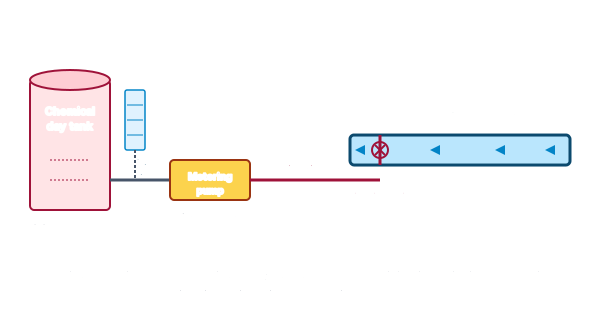
Anything you add to the water is a pounds-per-day problem.
lb/day = dose (mg/L) × flow (MGD) × 8.34
That 8.34 is just the weight of a gallon of water. It's what turns a concentration into a mass.
Here's where people give away points. The exam hands you a dose and a residual, and asks what's actually being used up. That's demand, and it's the difference between the two:
A 1.0-MGD plant doses chlorine at 3.0 mg/L and holds a 0.5 mg/L residual after contact. How many lb/day is the demand consuming?
Demand is 3.0 − 0.5 = 2.5 mg/L. Then run the pounds formula on that:
2.5 × 1.0 × 8.34 = 21 lb/day
If you'd used the full 3.0 you'd get 25 lb/day, and 25 will be sitting right there in the answer choices waiting for you. Subtract the residual first. Every time.
Stage 2: Sedimentation
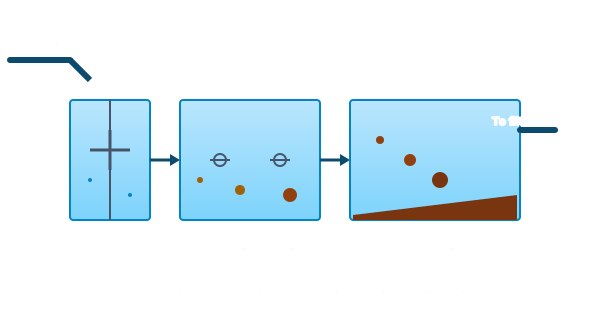
Settling basins get rated on how fast water crosses the surface, not how long it sits in there. Two rates show up.
Surface overflow rate is flow over surface area:
SOR (gpd/ft²) = flow (gpd) ÷ surface area (ft²)
A rectangular sedimentation basin is 75 ft long by 40 ft wide and treats 1.5 MGD.
Area's 75 × 40 = 3,000 ft², so 1,500,000 ÷ 3,000 = 500 gpd/ft².
Watch for more than one basin. Two basins sharing 4.0 MGD means each one only sees 2.0. Forget to split it and your answer comes out double.
Weir overflow rate is flow over the length of weir, in feet:
WOR (gpd/ft) = flow (gpd) ÷ weir length (ft)
A circular clarifier 50 ft in diameter has a weir around its full circumference and treats 2.0 MGD.
The weir length is the circumference, not the diameter. 3.14 × 50 = 157 ft, then 2,000,000 ÷ 157 = about 12,700 gpd/ft. Dividing by 50 is the miss I see most often on this one.
And read the stem properly here. If that clarifier has an inboard launder, the question will just tell you the weir length, and the circumference becomes the trap instead.
Stage 3: Filtration
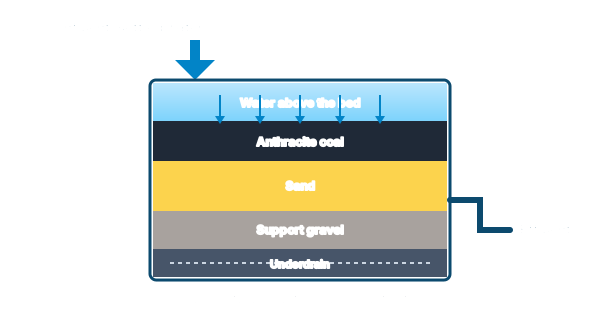
Filters are rated in gallons per minute per square foot. So the first thing you do is get the flow out of MGD and into gpm: divide by 1,440.
filtration rate (gpm/ft²) = flow (gpm) ÷ filter area (ft²)
2.0 MGD ÷ 1,440 = 1,389 gpm. Over a 200 ft² filter, that's 1,389 ÷ 200 = 6.9 gpm/ft².
Now the version that separates people:
A 30 MGD plant has six filters, each 400 ft². With one filter out for backwash, the rate on the rest is:
30 MGD = 20,833 gpm. And it's five filters in service now, not six, so 5 × 400 = 2,000 ft². That gives 20,833 ÷ 2,000 = 10.4 gpm/ft².
Which is well over the 4 to 6 gpm/ft² you'd normally design for. That's the real point of the question. It isn't testing division, it's testing whether you noticed what taking a filter offline does to the ones still running.
Backwash water shows up as a percentage problem too:
A plant produces 8.0 MG and uses 0.24 MG backwashing plus 0.06 MG for filter-to-waste.
In-plant use is 0.24 + 0.06 = 0.30 MG, so 0.30 ÷ 8.0 = 3.8%. Count the backwash on its own and you get 3.0% and you've dropped the filter-to-waste.
Stage 4: Disinfection and CT
CT is the one calculation that's really unique to drinking water, and it's worth more marks than how simple it looks.
CT = residual (mg/L) × effective contact time (minutes)
The word doing all the work there is effective. Theoretical detention time assumes the water marches through the basin in a neat plug. Real basins short-circuit, so the state knocks the time down with a baffling factor:
effective contact time = theoretical detention × baffling factor
A contact tank holds 50,000 gallons and the plant flows 0.25 MGD, with a baffling factor of 0.5.
Detention is 50,000 ÷ 250,000 = 0.2 day, which is 288 minutes. Apply the factor: 288 × 0.5 = 144 minutes. Skip that step and you're claiming 288 minutes of contact you don't actually have, which is the kind of thing that shows up in a sanitary survey.
Then they stack a compliance question on top:
Residual into the basin is 1.2 mg/L over 90 minutes of effective contact. The table requires 130 mg-min/L.
You achieved 1.2 × 90 = 108, so you're about 22 short and you need more residual or more contact time. Notice the answer isn't a number, it's a call. Treatment exams do that a lot. They want to know you can tell compliant from not, not just that you can multiply.
Stage 5: Finished water
Percent removal is just in versus out:
% removal = (in − out) ÷ in × 100
Influent 5.0 NTU, filtered 0.5 NTU: (5.0 − 0.5) ÷ 5.0 × 100 = 90%. Order matters. It's the change divided by what you started with, not what you ended with.
Three conversions cause most of the damage
I'd say the large majority of missed math problems aren't math at all. People get the arithmetic right and land in the wrong unit. Three conversions do most of it:
| Conversion | What to do | Where it bites |
|---|---|---|
| MGD to gpm | divide by 1,440 | Filtration rate, anything in gpm |
| Cubic feet to gallons | multiply by 7.48 | Tank volumes, detention time |
| mg/L to lb/day | × flow MGD × 8.34 | Every chemical feed problem |
One habit worth building, and it costs you four seconds: before you touch the numbers, write down the unit the answer needs. If it's gpm/ft², you've just told yourself you need a flow in gpm and an area in square feet, which tells you what conversions you owe before you start. That one line on the scratch paper kills most of these.
Go practice it
Reading about this and doing it are two different skills, and the exam only tests one of them.
- The operator math practice test is the bank these examples came out of. Free, explanation on every question.
- If you'd rather see this math mixed in with everything else, the way it actually shows up, try Water Treatment Class 1 or Class 2.
Which page you actually want
There are four pages here covering operator math and they do different jobs, so here's the honest map:
- This one walks the plant and tells you which formula belongs to which stage.
- Water Operator Math: The 3 Formulas comes at it from the other side: three formulas that cut across every discipline. Read that one if your problem is picking the formula rather than knowing the process.
- The practice test is where you get your reps in.
- Water Operator Math is the paid course. Eleven modules, every formula worked by hand on paper. Module 3 is free if you want to see how I teach it before you decide.
If your math is shaky all over, start with the three formulas guide. If you can do the arithmetic but keep reaching for the wrong formula, it's this page you want to reread.