How to Study for the Water Operator Certification Exam in 30 Days
If you've signed up for the water operator certification exam and the test date is about a month away, you're in the right window. Thirty days is enough time to cover every topic with reps to spare; seven days isn't enough, and ninety days is when most operators lose motivation and stop studying entirely. This guide is the week-by-week plan that consistently works for operators at every level: Class I, II, III, and IV (and the equivalent WPI-aligned classifications most states use).
Key takeaways
- Week 1: Foundations. Lock in operator math, basic chemistry, and terminology. ~10 hours total.
- Week 2: Treatment processes. Coagulation → flocculation → sedimentation → filtration → disinfection. ~12 hours total.
- Week 3: Distribution, regulations, safety, and sampling. ~10 hours total.
- Week 4: Full-length practice tests, weak-area review, and a final mock exam two days before. ~8 hours total.
- The day before: Light review of formulas + good sleep. No new material.
- Use the Level 1, Level 2, Level 3, and Level 4 practice tests + the math practice test and regulations practice test for reps, and the chemical dosage calculator when the math gets thick.
Why 30 days works (and why 7 days doesn't)
The water operator exam asks ~100 questions covering treatment chemistry, operator math, regulations, distribution, and safety. The questions are written to test understanding, not memorization. That means cramming the weekend before doesn't work, you'll recognize topics but freeze on the math.
Thirty days gives you:
- Time to drill operator math until it's automatic (the single highest-impact thing you can do)
- Multiple passes through every topic, so the second pass solidifies what the first pass introduced
- Full-length practice exams under exam conditions, which is how you find your weak areas
- A buffer for life, work, family, the day you don't feel like studying
The total time commitment is about 40 hours over 30 days, roughly 1.5 hours per weekday plus 3 hours each weekend day. If your schedule is lighter, stretch to 45 days. If you've been operating for years and just need to refresh, you can compress to 21.
Before day 1: what to gather
Spend an hour the day before you start to assemble your study materials. You'll need:
- A study reference book. Water Treatment Operator Handbook by Bill Lauer (AWWA, also known as the "Lauer book") and Basic Science Concepts and Applications for Operators by AWWA are the two most commonly referenced. Most operators only need one of these. State certification programs sometimes publish their own study guide, check your primacy agency's website.
- A simple four-function calculator. Most states don't allow graphing calculators on the exam. Use a $5 four-function calculator for the entire month so you build the right muscle memory.
- A notebook for formulas and worked problems. Paper, not phone notes. Writing problems out longhand reinforces them better than typing.
- A timer. Phone timer works. You'll want it for the practice tests in Week 4.
- Bookmarks for the free practice tests at your level, the math practice test, and the dosage calculator.
Block out study times in your calendar like appointments. The single most common reason operators fail isn't lack of intelligence, it's letting other priorities eat the study time.
Week 1: Foundations (days 1–7)
Goal: get fluent in the core math and chemistry that everything else builds on. If you skip this week, the treatment-process topics in Week 2 won't make sense.
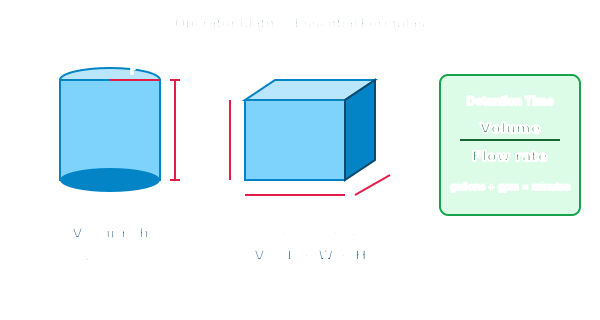
Days 1–3: Operator math. This is the highest-leverage three days of your entire study plan. Roughly a third of every exam's math questions reduce to one of three formulas: the dosage formula (lbs/day = mg/L × MGD × 8.34), detention time (T = V ÷ Q), and loading rate (Q ÷ A). The water operator math guide walks through all three with worked examples; read it carefully and do twenty problems of each type.
Days 4–5: Chemistry basics. pH, alkalinity, hardness, conductivity, total dissolved solids, turbidity, units (mg/L = ppm, µg/L = ppb). These are the building blocks of every treatment question. If your reference book has a "basic chemistry" chapter, work through it now.
Days 6–7: Terminology and units. Potable, palatable, raw water, finished water, MCL, MCLG, primary vs secondary standards. Run a quick pass through the Level 1 practice test, even if you're studying for a higher level, the Level 1 questions test terminology that gets assumed at higher levels.
End of week 1 checkpoint. You should be able to set up any dosage problem in under 30 seconds, identify whether a water is acidic or basic from its pH, and define every term on a typical primary-MCL table without looking. If you can't, spend an extra day on the gap before moving on.
Week 2: Treatment processes (days 8–14)
Goal: understand each unit process and why it's there. The exam tests both the concept (what does coagulation do?) and the operation (what should you do if floc isn't forming?).
Days 8–9: Coagulation and flocculation. Charge neutralization, common coagulants (alum, ferric chloride, polyaluminum chloride, polymers), rapid-mix design, flocculation basin design, jar tests. Run the coagulation practice test, 50 questions with explanations. Focus on jar-test interpretation; it's heavily tested at every level.
Days 10–11: Sedimentation and filtration. Surface overflow rate, sedimentation basin design, filter media (anthracite, sand, gravel), filter loading rate, backwashing, breakthrough. Run the filtration practice test and review filter loading rates (typically 2–4 gpm/ft² for dual-media filters).
Days 12–13: Disinfection. Chlorine chemistry (free vs combined, CT, breakpoint chlorination), chloramines, UV, ozone, DBPs. The breakpoint chlorination guide is worth reading; breakpoint questions show up at every level. Run the disinfection practice test.
Day 14: Chemical feed. Dosage calculations for chlorine gas, sodium hypochlorite, calcium hypochlorite, fluoride, fluorosilicic acid, alum. Run the chemical feed practice test and use the chemical dosage calculator to verify your scratch work.
End of week 2 checkpoint. You should be able to walk through a conventional treatment train from raw-water intake to finished-water storage, naming each unit process and its purpose. You should also be able to compute lbs/day of any common treatment chemical given the dose and plant flow.
Week 3: Distribution, regulations, and safety (days 15–21)
Goal: cover the topics that show up after treatment in the test outline, plus the regulatory/compliance background that ~25% of exam questions ask about.
Days 15–16: Distribution systems. Pipe materials, water mains, hydrants, storage (elevated, ground, hydropneumatic), pump types (centrifugal, vertical turbine), water age, disinfectant residual maintenance, main breaks, water hammer. Run the distribution practice test. For higher levels, also focus on pump curves, NPSH, and pressure-zone hydraulics.
Day 17: Storage and pumping calculations. Tank usage time, pump TDH, horsepower calculations. Run the storage and pumping practice test.
Days 18–19: Cross-connection control and sampling. The 7 backflow scenarios guide covers the most-tested cross-connection patterns. Then run the cross-connection practice test and the sampling practice test. Sampling covers chain-of-custody, sample preservation, and lab certification, sometimes ignored in study, but tested directly.
Day 20: Regulations. Safe Drinking Water Act, Surface Water Treatment Rule, Total Coliform Rule, Stage 1 and 2 D/DBP, Lead and Copper Rule Revisions (LCRR). The LCRR for operators guide walks through the trickier LCRR-specific content. Run the regulations practice test.
Day 21: Safety and operator responsibility. Lockout/tagout, confined space, chlorine gas safety, chemical handling, SCBA, recordkeeping. Light reading day before Week 4's hard reps.
End of week 3 checkpoint. You should be able to identify which regulation applies to a given operational scenario (e.g., "Stage 2 D/DBP" → THM/HAA5 monitoring), name the EPA's primary MCLs for common contaminants, and walk through a chlorine-gas response procedure.
Week 4: Full practice and review (days 22–30)
Goal: take full-length practice exams under exam conditions, identify your weak areas, and re-drill them.
Day 22: First full-length practice exam. Take the practice test that matches your exam level: Level 1, Level 2, Level 3, or Level 4. 100 questions, no time pressure on this first one. After scoring, mark every question you got wrong or guessed on.
Days 23–24: Weak-area drill. Review the topics that hurt you on day 22's exam. If math was the problem, do another 30 problems from the math practice test. If it was disinfection chemistry, re-read the breakpoint chlorination guide and do the disinfection practice test again.
Day 25: Second full-length practice exam. Same level test, 90 minutes max. You want to beat day 22's score by 5+ points. If you've done the work, you will.
Days 26–27: Final weak-area sweep. Whatever's still tripping you up gets one more round of focused drill.
Day 28: Mock exam under full conditions. Pick whichever level test you haven't fully exhausted yet (or run the topic tests as a hybrid set). Time yourself. No notes. This is your "are you ready" check. If you score 80%+, you're ready. If 70-80%, do one more weak-area sweep on day 29. If under 70%, consider pushing your exam date 1-2 weeks.
Day 29: Formula review and light reading. Re-read your own notes. Don't introduce new material this late. Make sure your three core formulas (dosage, detention time, loading rate) are still automatic.
Day 30 (exam day eve). Eat normally, no caffeine after noon if you're caffeine-sensitive, in bed by 10 PM. Light review of formulas only, 20 minutes max. Don't cram.
The day of the exam
- Eat a real breakfast. Protein + carbs. Not just coffee.
- Arrive 30 minutes early. Bring your ID, your calculator, and a non-electronic watch if allowed.
- First pass: easy questions. Answer everything you know on the first pass through the test. Skip anything that would take more than 90 seconds.
- Second pass: the math problems. Now spend the time on calculations. Use scratch paper, write the formula, plug in numbers, double-check units.
- Third pass: the leftovers. Tough conceptual questions where you have to reason through it. If you genuinely don't know, eliminate two clearly-wrong options and pick the best of what's left. Never leave a question blank, there's no penalty for guessing on most operator exams.
- Trust your preparation. If you've followed this plan, you've covered the material. The exam isn't trying to trick you.
Common mistakes operators make studying
These are the things that consistently sink otherwise capable operators.
- Skipping the math. Operators with field experience often think they don't need to drill math because they "know it from the job." Then they sit down with a calculator and a pH-adjustment problem and lose 5 points they shouldn't have.
- Reading instead of doing problems. Reading the Lauer book cover-to-cover is comforting but it's passive. You don't learn operator math by reading, you learn it by solving 200 problems. Practice tests are the active step.
- Studying only the level you're testing for. A Level 3 exam still has Level 1 material on it. Don't skip the foundations.
- Cramming the week before. Whatever you're cramming on day 28 you'll have forgotten by day 30. Spread the load.
- Ignoring weak areas. Operators love drilling the topics they already know. The math person does more math; the regs person does more regs. The fastest score improvement comes from doing the opposite, go after your worst topic, not your best.
- Skipping the time-pressure practice. The exam is timed. If you've only done untimed practice, you'll be slow in the actual test. Run at least one timed full-length test before exam day.
- Not knowing your state-specific rules. Most of the exam is WPI-aligned and applies everywhere, but every state has a few state-specific requirements. Check your state's /states page on this site, or your primacy agency's website, for state-specific exam content.
Where to read more
The standard reference texts are AWWA's Water Treatment Operator Handbook by Bill Lauer and Basic Science Concepts and Applications for Operators by Joanne Drinan. The Water Professionals International (WPI) publishes the Need-to-Know Criteria that every state's exam is based on; downloading the NTKC for your level is free and gives you the exact topic outline the exam follows. EPA's drinking water reference resources include free guidance documents on every major rule (SDWA, SWTR, LCRR, Stage 1/2 D/DBP).
Practice what you learned
The 30-day plan only works if you do the reps. The single biggest predictor of passing on the first try is total number of practice questions answered with explanations, operators who do 500+ practice questions before the exam pass at a much higher rate than those who do 100.
Start with the practice test matching your exam level: Level 1, Level 2, Level 3, or Level 4. Each is 100 questions with worked-out explanations on every one. Run the topic tests (math, disinfection, regulations, and the rest) to drill specific weak areas. When the calculations get thick, the chemical dosage calculator shows the formula step by step with your numbers plugged in.
Good luck. You've got this.