The Lead and Copper Rule Revisions: What Operators Actually Need to Know
The Lead and Copper Rule Revisions (LCRR) went into effect in 2021 and the first big deadline, the initial lead service line inventory, was October 16, 2024. Most operators have lived through the inventory scramble by now, but the rule is still actively reshaping how systems handle corrosion control, lead sampling, and customer communication. The LCRR also shows up heavily on the Level 3 and Level 4 water operator certification exams. This guide walks through what changed from the original LCR, what didn't, and the operational decisions you should already be making (or studying for).
Key takeaways
- The lead action level is still 0.015 mg/L at the 90th percentile, unchanged from the original LCR.
- The LCRR added a trigger level of 0.010 mg/L at the 90th percentile. Hitting the trigger requires planning actions, not necessarily new treatment.
- Systems must maintain a lead service line (LSL) inventory classifying every service line as Lead, Galvanized Requiring Replacement (GRR), Non-lead, or Unknown. Initial inventory was due October 16, 2024.
- A find-and-fix requirement now investigates individual tap samples above the action level, not just system-wide 90th percentiles.
- Full LSL replacement is required; partial replacement is generally prohibited.
- Community systems must sample for lead at the schools and child-care facilities they serve on a 5-year rotation.
- Drill the regulatory details with the free regulations practice test and the corrosion control practice test, and use the LSI calculator when evaluating corrosion-control chemistry.
What didn't change
Before listing the new provisions, it's worth being clear about what carried over. Both the rule's action levels and its core treatment-technique structure are unchanged from the original 1991 Lead and Copper Rule:
- Lead action level: 0.015 mg/L (15 µg/L), 90th-percentile compliance.
- Copper action level: 1.3 mg/L, 90th-percentile compliance.
- First-draw sampling from cold-water taps after at least 6 hours of stagnation.
- Tiered site selection: Tier 1 sites (homes with known lead service lines, lead solder used after 1982, or lead interior plumbing) come first.
- Optimal Corrosion Control Treatment (OCCT) remains the central treatment requirement. Most systems use orthophosphate, pH adjustment, alkalinity adjustment, or a combination.
- State primacy still administers most of the rule. Reviews and approvals go through your primacy agency, not directly through EPA.
The LCRR builds on top of all of that. It does not replace the action level, the 90th-percentile structure, or first-draw sampling.
The biggest change: trigger level
The most-tested LCRR change is the new trigger level of 0.010 mg/L (10 µg/L) at the 90th percentile. The trigger level sits below the 0.015 mg/L action level.
Crossing the trigger level doesn't put a system in violation. It triggers planning actions: re-optimization studies for OCCT, additional sampling, source water assessment, and (for systems with lead service lines) accelerated replacement planning. The goal is to catch deteriorating performance early, before a system crosses the action level.
On the exam, you'll see this distinction tested directly. A common question format: "A system's 90th-percentile lead is 0.012 mg/L. Has the system exceeded the action level?" Answer: no (0.012 is below 0.015), but it has crossed the trigger level and must implement planning actions per LCRR.
Find-and-fix at the individual tap
The original LCR was a population-level rule. Compliance was based on a system-wide 90th percentile. Individual high samples didn't trigger anything on their own; they just got averaged in.
The LCRR adds find-and-fix for any individual tap sample above the action level. Even if a system's 90th percentile is at or below 0.015 mg/L, a single tap sample above the action level requires the system to:
- Investigate the cause within 30 days.
- Re-sample at the same site within 30 days.
- Either correct the cause or determine that it's site-specific (e.g., a brass fitting on the customer's plumbing).
- Document everything and report to the primacy agency.
Find-and-fix puts much more weight on the individual sample than the original rule did. Operators preparing for the Level 3 and Level 4 exams should be able to walk through the procedure end to end.
The lead service line inventory
LCRR's inventory requirement was the biggest operational lift for most utilities. Every community water system (CWS) and non-transient non-community water system (NTNCWS) had to compile a publicly available inventory of every service line by October 16, 2024, classifying each as:
- Lead, known to be lead.
- Galvanized Requiring Replacement (GRR), galvanized that is or ever was downstream of a lead line. These accumulate lead and behave like lead lines.
- Non-lead: confirmed not lead (typically copper, plastic, or new ductile iron).
- Lead status unknown, records insufficient to classify.
The inventory must cover both the utility-owned portion (main to curb stop) and the customer-owned portion (curb stop to the home). That's a meaningful expansion, historically, utilities had only solid records for the public side.
Inventories must be updated as new information comes in (e.g., during service-line replacements, leak repairs, or premise plumbing inspections). Many utilities are still doing visual inspections and predictive modeling to clear "unknown" classifications.
Full lead service line replacement
Under the original LCR, when a system exceeded the action level, it was required to replace 7% of its lead service lines per year, but only the public-side portion. The customer-owned half could be left in place. This led to partial lead service line replacements, which research showed could actually increase lead release in the short term because they disturbed the protective scale layer.
LCRR generally prohibits partial replacement. When an LSL is being replaced, for compliance, emergency repair, or customer-initiated: the entire line, both public and private sides, must be replaced together. Exceptions are narrow (emergency repairs where the customer-side replacement can't be coordinated in time, with subsequent follow-up).
For operators, the operational implication is significant. Coordinating customer-side work, securing access, handling customers who refuse replacement, and avoiding partial replacement in emergencies all require new procedures.
School and child-care sampling
LCRR requires community water systems to sample for lead at elementary schools (or buildings serving children age 5 and under) and licensed child-care facilities they serve. The schedule:
- Sample 5 outlets per facility (drinking fountains and kitchen taps are typical).
- Test on a 5-year rotation. Each facility gets sampled at least once every five years.
- Post results publicly and notify the facility within 30 days.
- Provide educational materials to facilities about lead risks.
This is a notable expansion. Historically, schools weren't part of LCR compliance sampling. The new requirement reflects what we've learned about children's vulnerability to lead exposure and the prevalence of older lead-containing fixtures in school plumbing.
OCCT under LCRR
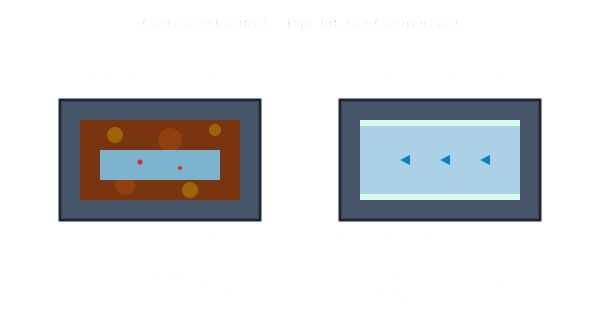
Optimal Corrosion Control Treatment didn't disappear, it intensified. Systems with lead service lines now have stricter expectations for maintaining OCCT and for re-optimizing when conditions change. Crossing the trigger level requires an OCCT re-optimization study. The state primacy agency reviews and approves the resulting OCCT changes.
Most systems use one or more of these OCCT strategies:
- pH adjustment with caustic soda or lime, targeting pH 7.5–8.5 in distribution
- Alkalinity adjustment (commonly with sodium carbonate or sodium bicarbonate), targeting ≥ 30 mg/L
- Orthophosphate inhibitor at 0.5–3 mg/L as PO₄ (or 0.3–1 mg/L as P), forming a lead-phosphate film on plumbing surfaces
- Zinc orthophosphate for systems that also need additional copper or galvanized protection
Water Quality Parameter (WQP) monitoring tracks performance: pH, alkalinity, orthophosphate residual, and sometimes temperature, calcium, and conductivity. Excursions outside the state-approved WQP ranges require investigation and reporting.
The LSI calculator is a useful sanity check on the chemistry, a slightly positive Langelier index is consistent with proper OCCT, while persistently negative LSI suggests corrosive water that probably needs treatment adjustment.
Customer-requested sampling
LCRR added a requirement that community water systems provide tap sampling at no charge to any customer who requests it, with results delivered within 30 days. This is a public-participation provision. Customer-requested samples aren't part of compliance sampling, but the data must be considered when evaluating find-and-fix and OCCT performance.
In practice, utilities are getting more sampling requests than they used to, which has implications for sampling-program capacity and customer-service workflows.
Common mistakes on LCRR exam questions
These show up on Level 3 and Level 4 exams, and they trip up operators in real conversations with regulators.
- Confusing the trigger level with the action level. Trigger level is 0.010 mg/L (planning). Action level is 0.015 mg/L (compliance / replacement requirements). Both are 90th-percentile.
- Forgetting find-and-fix applies even when 90th percentile is in compliance. A system with 90th-percentile at 0.008 mg/L can still have an individual sample above 0.015 mg/L. Find-and-fix kicks in for that single sample.
- Treating partial replacement as still acceptable. LCRR prohibits partial replacement in nearly all cases. Knowing the exceptions is the question on the exam.
- Missing GRR. Galvanized lines downstream of a (current or former) lead line are classified as GRR and treated like lead lines under LCRR. They're not just "non-lead galvanized."
- Mixing up the inventory deadline. October 16, 2024 was the initial inventory deadline. Inventories must be updated continuously thereafter.
- Forgetting about NTNCWSs. Non-transient non-community water systems (schools that own their well, prisons, certain workplaces) also have to comply with LCRR, not just community water systems. The school-sampling rules are slightly different for systems that already serve schools as their primary purpose.
- Assuming OCCT is "set and forget." Trigger-level exceedance requires OCCT re-optimization. WQP excursions require investigation. LCRR expects active management, not autopilot.
Where to read more
The actual rule text is at 40 CFR 141 Subpart I (Lead and Copper). EPA's drinking water rule resources host compliance guidance, fact sheets, and the inventory templates many utilities used. AWWA publishes peer-reviewed best-practice manuals on LSL inventory and replacement that are worth reading before kicking off a service-line program.
For the exam, both the regulations practice test and the corrosion control practice test cover LCRR specifically. Each is 50 questions with worked-out explanations.
Practice what you learned
LCRR isn't going away, and it's not just an exam topic: it's reshaping how utilities sample, treat, and communicate about lead and copper. The next step is reps: run the free regulations practice test for the LCRR-specific questions and the corrosion control practice test for the chemistry behind OCCT. When you're evaluating treatment chemistry, the LSI calculator gives you a quick read on whether your water is balanced, scale-forming, or corrosive.