Water & Wastewater Operator Salary: What Operators Earn
If you're thinking about becoming a water or wastewater operator, or you're already licensed and wondering whether you're being paid fairly, the first question is usually the simplest: what does this job actually pay? Here's the honest answer, straight from federal wage data, plus the things that decide where you land in that range.
Key takeaways
- The national median wage is about $58,260 a year (roughly $28 an hour) for water and wastewater treatment plant and system operators, per the U.S. Bureau of Labor Statistics (May 2024).
- The range is wide: the lowest 10% earn under ~$37,870, the highest 10% earn over ~$86,160. Where you fall depends mostly on license grade, experience, system size, and location.
- Pay is fairly steady across employers, but local government (which employs about 3 in 4 operators) and utilities sit right around the median.
- The biggest lever you control is your license grade, climbing from an entry certification to the higher grades is what moves you from the bottom of that range toward the top.
- The field is stable work: BLS projects employment to dip slightly, but about 10,700 openings a year, almost entirely from retirements and people leaving the field.
- Ready to move up a grade? That starts with the exam: drill it free on the drinking water, wastewater, distribution, and collections practice tests.
The national number
According to the Bureau of Labor Statistics, the median annual wage for water and wastewater treatment plant and system operators was $58,260 in May 2024. Median means the middle: half of operators earned more, half earned less. For comparison, the median for all U.S. occupations that year was $49,500, so operators sit comfortably above the national middle, not bad for a job you can enter with a high school diploma and on-the-job training.
But the median hides a big spread, and the spread is the interesting part:
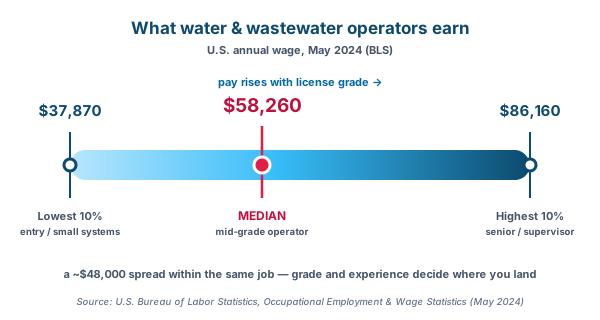
That's a roughly $48,000 gap between the bottom and the top of the same occupation. Almost nobody starts at the top: but the path from one end to the other is well-marked, and it runs straight through your certification grade.
What actually moves your pay
License grade: the lever you control
This is the big one, and it's why this whole site exists. Nearly every state licenses operators in multiple grades or classes (Grade 1 through 4, Class D through A, T1 through T5, and so on). Each step up lets you run larger, more complex systems with less supervision, and pay tracks responsibility. The entry-level operator watching gauges on a small system is near the bottom of that wage range; the higher-grade operator who can run a large plant, and the shift supervisor who oversees a team, are up near that top decile.
You don't control the economy or your zip code, but you do control how many grades you climb. Every grade you earn is a documented raise lever. (New to how the grades stack up? Start with water operator certification levels explained.)
Experience and seniority
Operator pay rewards tenure. Because so many operators work for municipalities and utilities, raises often follow step-and-grade pay scales tied to years of service, plus cost-of-living adjustments. Stick around, keep your license current, and your pay climbs even within the same grade.
Who you work for
Most operators, about 74%, work for local government (city and county utilities). The rest are spread across private utilities (13%), manufacturing (4%), and waste management and remediation (2%). Median pay is remarkably flat across these:
| Industry | Median annual wage (May 2024) |
|---|---|
| Waste management & remediation | ~$58,540 |
| Local government | ~$58,470 |
| Utilities | ~$57,820 |
| Manufacturing | ~$56,900 |
| Professional/scientific/technical services | ~$52,820 |
The takeaway: don't choose an employer on base wage alone, the bigger differences come from benefits. Municipal and utility jobs often carry pensions, strong health coverage, and overtime that a raw salary number doesn't show.
Overtime, shift differentials, and on-call
Treatment plants run 24/7/365. That means rotating shifts, nights, weekends, and on-call duty, and the pay that comes with them. Shift differentials and overtime (storm events, emergencies, covering open shifts) can add a real chunk to base pay, especially at smaller utilities that run lean. If you compare two offers with the same salary, the one with more overtime opportunity may pay noticeably more in practice.
Geography
Pay varies a lot by state and even by metro area, mostly tracking cost of living and how unionized the local workforce is. As a rule of thumb, wages run highest in higher-cost states, California, Washington, and much of the Northeast, and lower across parts of the South and rural Midwest. Because these numbers shift every year, the most reliable way to see your market is the BLS state and metro map for this occupation, linked in the sources below.
Water vs. wastewater vs. distribution and collections
BLS lumps drinking-water and wastewater treatment operators into a single wage category, so the headline numbers above cover both. In practice, pay is broadly similar across the disciplines: what matters more is grade, system size, and region than whether you're treating drinking water, running a distribution system, maintaining collections, or operating a wastewater plant. Many operators are dual-certified (for example, water and wastewater, or treatment and distribution), and stacking certifications is another proven way to raise your value to an employer.
Is it stable work? The job outlook
Here's a number that looks scary until you read the second half: BLS projects employment of water and wastewater operators to decline about 7% from 2024 to 2034, as automation lets plants run with fewer people. But the same projection expects about 10,700 job openings every year over the decade, almost all of them from operators retiring or leaving the field, not from new positions.
Translation: this is a graying workforce. A large share of current operators are nearing retirement, and utilities are working hard to replace them. For someone entering now with a license in hand, that's a genuinely favorable hiring picture: steady, essential work that can't be offshored, with a wave of retirements opening seats.
How to actually raise your pay
If you take one thing from this page: the fastest, most reliable raise in this field is the next license grade. It's the one variable that's fully in your hands, it's recognized everywhere, and it directly maps to that $38K-to-$86K spread.
The path is the same everywhere: meet the experience requirement for the next grade, then pass the exam. The exam is the gate: and it's exactly what we help you clear, for free. Pick your discipline and grade and start drilling:
- Drinking water treatment practice tests
- Wastewater treatment practice tests
- Water distribution practice tests
- Wastewater collection practice tests
Want a plan instead of a pile of questions? Follow the 30-day study plan. Brand new to the field and want the full on-ramp? See how to become a water operator and your state's guide from the states page.
This guide summarizes federal wage data for general information and is not a guarantee of pay. Actual wages depend on your grade, experience, employer, union status, and location, and the figures above are national estimates that BLS updates annually, check the live sources below for the latest and for your specific state. Reviewed June 2026.