What Is BOD in Wastewater? An Operator's Guide
If there's one number that runs a wastewater plant, it's BOD. It's the measure of how much organic pollution is in the water, the "food" your treatment bugs have to eat, and it's the number your discharge permit is built around. Operators live and die by it. Here's what BOD actually is, how the lab measures it, and what you do when it's too high.
Key takeaways
- BOD = biochemical oxygen demand: the amount of dissolved oxygen that microorganisms use to break down the organic matter in water. More organic pollution → higher BOD.
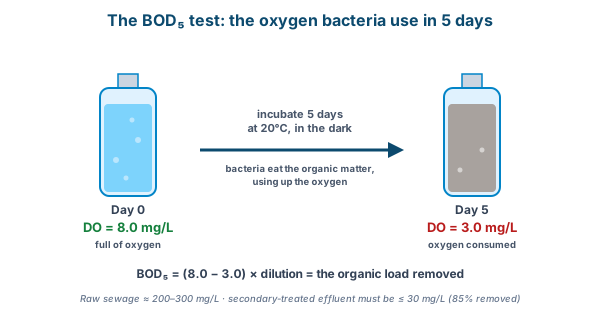
- It's measured by the BOD₅ test: incubate a sample for 5 days at 20 °C in the dark, and the drop in dissolved oxygen is the BOD.
- Typical numbers: raw domestic wastewater runs about 200–300 mg/L; the EPA secondary-treatment standard for effluent is 30 mg/L (30-day average) and at least 85% removal.
- BOD is the load your biological process must remove and the limit in your NPDES permit: it drives aeration, sludge age, and compliance.
- COD measures all chemically oxidizable matter and is always higher than BOD; it's a faster test.
- Drill it on the wastewater characteristics & sampling test and the Class I–IV wastewater tests.
What BOD actually measures
Put organic matter (sewage, food waste, etc.) and bacteria together in water, and the bacteria go to work eating the organics: and breathing oxygen to do it, just like we do. The more organic material there is, the more oxygen the bacteria consume.
BOD captures exactly that: it's the amount of dissolved oxygen microorganisms will use up breaking down the organic matter in a water sample over a set time. So BOD is really a stand-in for "how much organic pollution is in this water." High BOD = lots of organic load; low BOD = clean.
It matters to the environment because if you dump high-BOD water into a river, the bacteria there will pull oxygen out of the river to eat it, suffocating fish and aquatic life. Removing BOD before discharge is the whole point of secondary treatment.
The BOD₅ test: how the lab measures it
BOD is measured, not calculated, with the standard 5-day BOD test (BOD₅):
- Measure the dissolved oxygen (DO) in the sample on day 0.
- Seal the bottle and incubate it for exactly 5 days at 20 °C, in the dark (dark so algae don't produce oxygen and skew it).
- Measure the DO again on day 5.
- The drop in DO, adjusted for how much the sample was diluted, is the BOD in mg/L.
In short: BOD₅ = (initial DO − final DO) × dilution factor. Strong samples like raw influent have to be diluted heavily with prepared dilution water, because there isn't enough oxygen in the bottle to satisfy all that demand otherwise. Many plants run CBOD (carbonaceous BOD), which adds a nitrification inhibitor so the test measures only the carbon-eating demand, not the oxygen used by nitrifiers. (For the lab side, see wastewater sampling and lab.)
The catch every operator knows: results take 5 days to come back, so BOD tells you what your plant did last week, not right now. That's why operators lean on faster, real-time indicators (DO, MLSS, settleability) to run the process day to day.
The numbers worth memorizing
| Where | Typical BOD |
|---|---|
| Raw (untreated) domestic wastewater | ~200–300 mg/L |
| After primary treatment | ~120–180 mg/L |
| High-strength industrial waste (e.g., food processing) | 300–3,000+ mg/L |
| Secondary-treated effluent (EPA standard) | ≤ 30 mg/L (30-day avg) |
That last line is the big one: under the federal secondary-treatment standard (40 CFR Part 133), effluent BOD₅ must average 30 mg/L or less (45 mg/L as a 7-day average) and the plant must remove at least 85% of the incoming BOD. Your NPDES permit may be even tighter.
Why operators care so much
BOD is two things at once, and both run your plant:
- It's the load. Influent BOD is the amount of food entering the biological process. It sets how much air (oxygen) the bugs need, how much sludge you'll make, and your F/M ratio (food-to-microorganism). A slug of high BOD can overwhelm an aeration basin.
- It's the limit. Effluent BOD is what you're judged on. Blow the BOD limit and you have a permit violation. So everything in secondary treatment, DO control, sludge age, RAS/WAS, is ultimately about getting effluent BOD down and keeping it there. (See activated-sludge process control.)
What causes high BOD
High influent BOD usually means something added organic load:
- Industrial discharges: food processing, breweries, dairies, and similar high-strength waste.
- Fats, oils, and grease (FOG) and septage hauled to the plant.
- A concentrated (low-flow) influent, or strong waste with little dilution.
High effluent BOD (the one that gets you a violation) almost always means the biological process isn't removing it, from causes like:
- Low dissolved oxygen in the aeration basin, the bugs can't keep up.
- Solids carryover from a poorly settling clarifier (bulking sludge), BOD leaves in the suspended solids.
- A toxic or hydraulic shock that hurt or washed out the biomass.
- Too short a sludge age (MCRT), not enough bugs to do the work.
(Troubleshooting these is its own skill, see activated-sludge troubleshooting.)
How operators reduce BOD
BOD comes down in stages, and the operator's job is mostly about keeping the biology healthy:
- Primary treatment settles out a chunk of the BOD (the settleable organic solids) before biology even starts.
- Secondary (biological) treatment does the heavy lifting, the activated-sludge bugs (or fixed-film media) consume the dissolved and fine BOD. Keep them fed and aerated: adequate DO (~2 mg/L), the right sludge age, and steady RAS/WAS.
- Pretreatment programs make industries reduce their BOD before it ever reaches the plant.
- Flow equalization smooths out slugs so the biology isn't shocked.
When the process is healthy, a plant routinely knocks 200–300 mg/L of influent BOD down to single digits, well under the 30 mg/L limit.
BOD vs. COD (and CBOD)
You'll see these together on the exam:
- BOD measures only the biodegradable organic matter, what bacteria will actually eat, over 5 days.
- COD (chemical oxygen demand) uses a strong chemical oxidizer to measure everything that can be oxidized, biodegradable or not. So COD is always higher than BOD, and the test takes a couple of hours instead of five days. A high COD-to-BOD ratio signals waste that's hard to treat biologically.
- CBOD is BOD with nitrification suppressed, so it counts only carbon demand.
Practice it
BOD is one of the most-tested concepts in wastewater: expect questions on the 5-day test, the 30 mg/L standard, BOD vs. COD, and BOD-based loading math. Drill it on the wastewater characteristics & sampling test and the Class I–IV wastewater tests, and pair this with how a wastewater treatment plant works and activated-sludge process control. For BOD loading and removal math (the pounds formula and percent removal), see the wastewater operator math formulas.
This guide is a free study aid covering general wastewater practice. Test procedures, typical values, and permit limits vary by facility and regulation: always follow Standard Methods, your plant's process-control program, and your NPDES permit, and confirm specifics with your supervisor. Reviewed June 2026.