What Is Preliminary Treatment of Wastewater?
Raw wastewater shows up at the plant carrying everything people put down drains and toilets, and a lot of it has no business going through a pump or a treatment process: rags, wipes, sticks, plastic, rocks, sand, and grit. Preliminary treatment is the plant's bouncer. It pulls out the big stuff and the gritty stuff first, so the delicate (and expensive) equipment downstream doesn't get clogged, jammed, or ground to pieces. It's the least glamorous part of the plant and one of the most important.
Key takeaways
- Preliminary treatment is the first stage at a wastewater plant. Its job is to remove or shred large debris and remove grit to protect the pumps and processes downstream.
- Bar screens (racks) catch rags, plastics, sticks, and other large solids, the captured material is called screenings and gets hauled to a landfill.
- Comminutors and grinders are an alternative that shred the solids in place instead of removing them.
- Grit chambers drop out the heavy inorganic grit, sand, gravel, eggshells, coffee grounds, that would otherwise abrade pumps and pile up in tanks and digesters. The three types are horizontal-flow (velocity-controlled), aerated, and vortex.
- Preliminary treatment does not remove dissolved or fine organic pollution, that's the job of primary and secondary treatment.
- Drill it on the preliminary & primary treatment practice test.
What it is: and why it matters
Preliminary treatment is purely protective. It doesn't clean the water in any meaningful chemical sense; it removes the material that would damage or clog the plant. Skip it (or run it poorly) and you pay for it downstream: rag-balls wrapping pump impellers, grit wearing out pumps and piping, clogged pipes, and grit building up in clarifiers and digesters where it steals capacity and is miserable to remove. Every dollar and hour spent here saves many more later.
The work happens in two jobs: screening out the large solids, and removing grit.
Screening: bar screens and comminutors
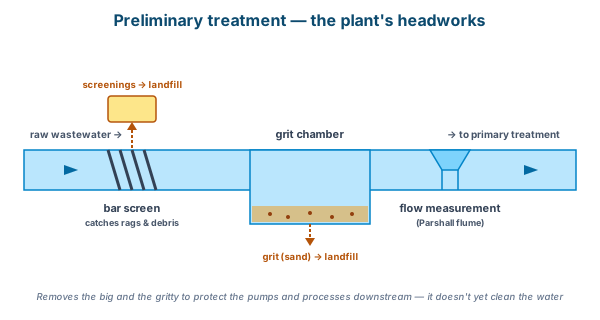
The first thing the flow hits is usually a bar screen (also called a bar rack), a set of parallel bars set at an angle across the channel. Water passes through; anything bigger than the bar spacing is caught.
- Coarse screens have wide spacing (roughly 1–3 inches) and catch the big stuff.
- Fine screens have tighter openings and catch more, including a lot of the wipes and rags that plague modern plants.
- Screens are cleaned mechanically (automated rakes) or, at small plants, by hand.
The material raked off is screenings, wet, smelly, and surprisingly heavy: and it's collected, drained, and hauled to a landfill. Handling and disposing of screenings (and the odor and housekeeping that come with them) is a daily reality of running the headworks.
A different approach is the comminutor (or grinder/muffin monster), essentially a heavy-duty version of a garbage disposal set in the channel. Instead of removing the solids, it shreds them so they pass through to be handled downstream. It avoids the screenings-disposal chore but sends the shredded material on into the plant, which has its own trade-offs (shredded rags can re-knit into ropes around equipment).
Grit removal: protecting the pumps
After screening comes grit removal. Grit is the dense, heavy, inorganic material, sand, gravel, cinders, eggshells, coffee grounds, bone fragments, that settles fast and is brutally abrasive. Left in the flow, it sandblasts pump impellers, wears out piping, and accumulates in tanks and digesters where it cuts into capacity.
The trick is to slow the water down just enough to let the heavy grit settle out while keeping the lighter organic solids suspended (you want to remove grit, not the organics, which belong in later treatment). There are three common designs:
- Horizontal-flow (velocity-controlled) grit chamber. The channel is sized to hold the velocity near about 1 foot per second, the sweet spot where grit settles but organics stay moving.
- Aerated grit chamber, air is bubbled along one side, rolling the water in a spiral. The heavy grit drops to the bottom while the rolling action keeps the organics from settling. Air rate tunes how much settles.
- Vortex grit chamber: the flow is spun in a cylindrical tank, and centrifugal force throws the grit to the outside and down into a collection sump.
The collected grit is washed (to drain off the organics) and, like screenings, landfilled.
Flow measurement and equalization
The headworks is also usually where the plant measures incoming flow, commonly with a Parshall flume or a flow meter, because nearly every downstream calculation and dosing decision depends on knowing the flow. Some plants also include flow equalization here, a basin that buffers the daily peaks and valleys so the rest of the plant sees a steadier, easier-to-treat flow.
What operators watch at the headworks
- Screen cleaning and blinding. A screen that isn't cleaned "blinds" (clogs), backs up the channel, and can overflow. Mechanical rakes and their controls need attention.
- Screenings and grit handling. Containers fill, drain, and smell; disposal and housekeeping are constant.
- Grit chamber tuning. Too aggressive and you pull out organics (and overload grit handling); too gentle and grit carries through to wreck pumps. Aeration rate and velocity are the knobs.
- Odor and corrosion. Headworks are a top source of hydrogen sulfide odor and corrosion, see hydrogen sulfide and sewer corrosion.
- Safety. Confined spaces, moving mechanical equipment, slippery surfaces, and gases make the headworks one of the more hazardous areas of the plant.
Practice it
Preliminary treatment, screens, comminutors, grit chambers, and the velocities involved, is bread-and-butter material on entry-level wastewater exams. Drill it on the preliminary & primary treatment practice test and the broader wastewater treatment practice tests, and pair this with how a wastewater treatment plant works. For the flow and velocity math, see the wastewater operator math formulas.
This guide is a free study aid covering general wastewater practice. Equipment, screen openings, and design velocities vary by plant: always follow your facility's process-control program and your supervisor's direction, and observe confined-space and gas-monitoring safety procedures. Reviewed June 2026.
Sources
- Preliminary Wastewater Treatment (US EPA, NPDES operator webinar)
- Preliminary Treatment (Workforce LibreTexts)
When you're ready to check yourself, take a full wastewater treatment test: every class level, free, with an explanation on every question.