Langelier Saturation Index (LSI) Calculator
Enter five values from your lab report to see whether your water is corrosive, balanced, or scale-forming.
Inputs
Result
Show formula with your numbers
How LSI is calculated
The four sub-factors are:
A = (log10[TDS] − 1) / 10 ·
B = −13.12 × log10(T + 273) + 34.55 ·
C = log10[Ca²⁺ as CaCO₃] − 0.4 ·
D = log10[Alkalinity as CaCO₃]
Temperature in factor B is in degrees Celsius. The other inputs are in mg/L. pHs is the saturation pH: the pH at which water would be exactly in equilibrium with solid calcium carbonate at your specific TDS, temperature, calcium, and alkalinity.
Interpreting your result
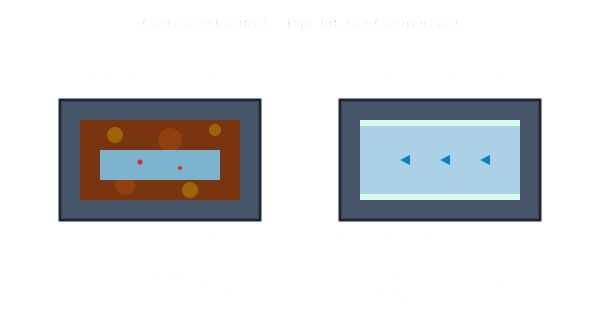
- LSI < 0, Water is undersaturated. It will dissolve calcium-carbonate scale and tends to be corrosive to metal pipes and fixtures.
- LSI ≈ 0 (±0.3), Water is in equilibrium with CaCO₃. Neither corrosive nor scale-forming.
- LSI > 0, Water is supersaturated. It will deposit calcium-carbonate scale on pipes, water heaters, and fixtures.
In practice, distribution systems aim for a slightly positive LSI (+0.1 to +0.5) to maintain a thin protective scale that isolates pipe metal from the water without causing excessive deposits.
When LSI isn't enough
LSI is a screening index, it tells you the tendency but not the rate. For more detailed analysis, operators also use the Ryznar Stability Index (RSI), the Aggressive Index (AI), and the Calcium Carbonate Precipitation Potential (CCPP). At very high TDS (>~10,000 mg/L) the simple LSI assumptions break down and a more rigorous calculation like the Stiff & Davis Stability Index is appropriate.
LSI vs. other water-stability indices
LSI is the simplest of several indices used to evaluate the calcium-carbonate stability of drinking water. Each has a slightly different scale and intended use.
| Index | Formula | Interpretation | Best for |
|---|---|---|---|
| Langelier (LSI) | pH − pHs | Negative = corrosive; 0 = balanced; positive = scale-forming | Drinking-water screening, certification exams |
| Ryznar (RSI) | 2·pHs − pH | <6 scale; 6–7 balanced; >7 corrosive | Cooling-water systems |
| Aggressive (AI) | pH + log(Ca·Alk) | <10 aggressive; 10–12 moderate; >12 non-aggressive | Asbestos-cement pipe evaluation |
| Stiff & Davis (S&DSI) | Like LSI, but ionic-strength corrected | Same scale as LSI | Seawater / brackish water (high TDS) |
| CCPP | mg/L CaCO₃ that would precipitate | Negative = will dissolve; positive = will deposit | Quantitative scale-rate prediction |
Common operator mistakes with LSI
- Mixing up calcium hardness with total hardness. LSI uses calcium hardness specifically, not total hardness. If your lab reports only total hardness, ask for a calcium hardness titration.
- Using alkalinity as mg/L HCO₃⁻ instead of CaCO₃. All inputs to LSI use mg/L as CaCO₃. To convert HCO₃⁻ to CaCO₃, multiply by 0.82.
- Forgetting to convert °F to °C. The B factor uses absolute temperature in Kelvin (T_°C + 273.15). The calculator's unit toggle does this for you.
- Applying LSI to high-TDS water. LSI's TDS factor (A) is a rough approximation that fails above about 10,000 mg/L. Use the Stiff & Davis index for seawater, brackish water, or concentrated brines.
- Reading LSI as a rate. LSI is a thermodynamic tendency, not a rate. Two waters with the same LSI can scale at very different speeds depending on kinetics.
- Ignoring temperature stratification. LSI calculated at distribution temperature is balanced; the same water inside a 60 °C water heater is supersaturated. Always note which temperature you used.
When to use this calculator
Use it for distribution-system corrosion-control evaluation, for Lead and Copper Rule (LCR) decisions about pH and alkalinity adjustment, for studying the Level 3 and Level 4 operator certification exams (LSI questions are common at advanced levels), and as a quick check when blending two source waters to predict the stability of the mixed product. For pool and spa water, LSI is the industry-standard stability index, though the target range is wider (±0.5) than drinking water.
Frequently asked questions
What is a good LSI value for drinking water?
Is a positive LSI bad?
What is the difference between LSI and Ryznar Stability Index (RSI)?
How does temperature affect LSI?
Can LSI predict actual scaling rates?
What does LSI mean for the Lead and Copper Rule?
Related practice tests
Other operator calculators
- Chemical Dosage calculator, lbs/day at any dose and flow
- Silt Density Index (SDI) calculator, RO/NF feed-water fouling test
- See all calculators →
Disclaimer: This calculator is provided as a free study aid. Always verify treatment-plant decisions against a current bench-scale analysis and your state primacy agency's guidance under the EPA Lead and Copper Rule.