How Wastewater Collection Systems Work
Everyone thinks about the treatment plant. Almost nobody thinks about how the wastewater gets there: the buried network of pipes, manholes, and pump stations that carries sewage from thousands of toilets, sinks, and drains across town to a single plant. That network is the collection system (sometimes called the wastewater conveyance system), and keeping it flowing is a whole operator discipline of its own. Here's how it works.
Key takeaways
- A collection system moves wastewater from buildings to the treatment plant, mostly by gravity, pipes laid on a continuous downhill slope.
- Flow runs from a building's lateral into progressively larger mains, trunk sewers, and interceptors, with manholes for access along the way.
- When the ground won't cooperate, a lift station (a wet well + pumps) lifts the wastewater and pushes it uphill through a pressurized force main.
- Where gravity is impractical across a whole area, utilities use low-pressure (grinder pump) or vacuum sewer systems instead.
- The operator's constant enemy is I&I, infiltration and inflow: clean water leaking into the sewer, stealing treatment capacity and causing overflows.
- Drill it on the wastewater collection practice tests, and go deeper with gravity sewers and lift stations.
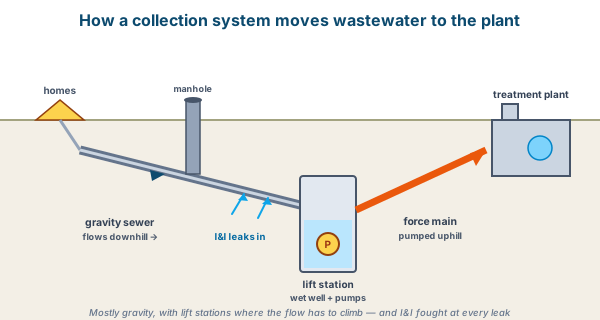
The basic idea: let gravity do the work
The cheapest, most reliable way to move wastewater is to let it flow downhill, so collection systems are built around gravity wherever the terrain allows. Pipes are laid at a carefully designed slope: steep enough to keep the flow moving fast enough to carry solids along (self-cleansing velocity), but not so steep that the liquid outruns the solids and leaves them behind.
The flow gathers as it goes, like streams joining a river:
- Service lateral, the small pipe from a building to the street.
- Collector mains, the neighborhood pipes the laterals empty into.
- Trunk and interceptor sewers, progressively larger pipes that carry the combined flow toward the plant. Gravity sewer pipe commonly ranges from about 6 inches at the edges to 48 inches or more on the big interceptors, sized for peak flow without clogging.
Unlike a pressurized water main, a gravity sewer normally runs partly full, with air space above the flow: which matters, because that headspace is where sewer gases (and corrosion) live.
Manholes: the system's access points
Every so often, at junctions, changes in pipe size, changes in direction or slope, and at regular intervals on straight runs: the system has a manhole. Manholes let operators inspect, clean, and CCTV the lines, and they're where a lot of collection work happens. They're also a common entry point for the clean water that causes I&I (more on that below).
When gravity can't: lift stations and force mains
Towns aren't all downhill. When the sewer would otherwise have to be buried impractically deep, or it needs to climb over a ridge to reach the plant, the system switches from gravity to pumping.
- A lift station (also called a pump station) has a wet well, an underground chamber where incoming wastewater collects. As the level rises, controls start the pumps; as it drops, they stop. Most stations run two pumps that alternate to share the wear and provide backup.
- The pumps push the wastewater up and out through a force main: a pressurized pipe (unlike the gravity sewers, this one runs full and under pressure). The force main carries the flow up to a higher point, where it discharges back into a gravity sewer or heads on toward the plant.
Lift stations are critical points: if one fails and the wet well overflows, you get a sanitary sewer overflow (SSO): exactly what operators work to prevent with alarms, backup power, and maintenance.
The alternatives: low-pressure and vacuum sewers
In flat areas, high-groundwater areas, or new developments where deep gravity trenching is too expensive, utilities sometimes skip gravity mains entirely:
- Low-pressure (grinder pump) systems. Each home has a small grinder pump that shreds the solids and pushes the wastewater into a small-diameter pressure main. Good for low-density and flat terrain.
- Vacuum sewer systems, a central vacuum station holds the whole network under negative pressure. At each connection, wastewater collects in a valve pit until a set amount accumulates (around 10 gallons), then a vacuum valve snaps open and the difference in pressure rockets the slug of wastewater into the main at high velocity toward the station. Well-suited to flat sites and high water tables.
Most systems are a hybrid: mostly gravity, with lift stations and the occasional pressure or vacuum area where it makes sense.
The operator's nemesis: inflow and infiltration (I&I)
If you talk to a collection-system operator for five minutes, I&I will come up. It's clean water getting into a system that's only supposed to carry sewage, and it's a chronic, expensive problem:
- Infiltration: groundwater seeping in through cracked pipes, bad joints, and deteriorated manholes. It's worst when the water table is high.
- Inflow, stormwater pouring in through improper connections: sump pumps, roof drains, cellar and yard drains, and holes in manhole covers. It spikes hard during rain.
Why operators fight it: every gallon of clean water that leaks in is a gallon you now have to pump and treat for no reason. Bad enough I&I can overwhelm pipes and lift stations during storms, causing SSOs and basement backups, and it inflates energy and chemical costs year-round. Finding and sealing it, through smoke testing, CCTV inspection, and rehab, is a core part of running a collection system. (For more, see collection system maintenance and I&I.)
What operators actually do
Running a collection system is preventive work: keeping the pipes clear and the flow moving so it never makes the news. Day to day that means cleaning lines (jetting and rodding) to stop grease and root blockages, CCTV inspection to find defects before they fail, manhole and lift-station maintenance, odor and corrosion control (hydrogen sulfide eats concrete and is dangerous: see hydrogen sulfide and sewer corrosion), and chasing down I&I. Most utilities run all of this under a CMOM (Capacity, Management, Operations, and Maintenance) program aimed at preventing overflows.
Practice it
Collection-system topics, gravity flow, lift stations, force mains, I&I, and SSO prevention, are the heart of the wastewater collection exams. Drill them on the wastewater collection practice tests, and pair this overview with gravity sewers and lift stations, collection system maintenance and I&I, and hydrogen sulfide and sewer corrosion. For the math, see the collections operator math formulas.
This guide is a free study aid covering general collection-system practice. Designs, pipe sizes, and standards vary by utility and region: always follow your system's specifications and your supervisor's direction, and observe confined-space and gas-monitoring safety procedures. Reviewed June 2026.