Silt Density Index (SDI) Calculator
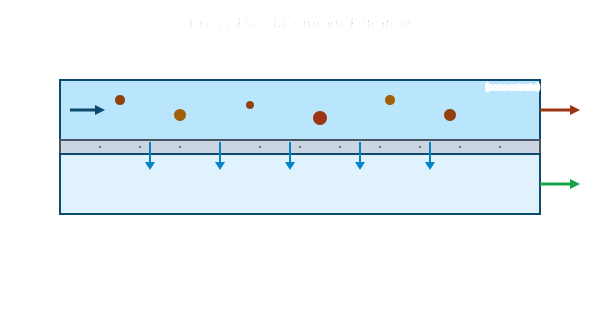
Free Silt Density Index (SDI) calculator following the ASTM D4189 procedure. The SDI test measures the membrane-fouling potential of feed water for reverse osmosis (RO), nanofiltration (NF), and other pressure-driven membrane systems. You filter 500 mL of water through a fresh 0.45 µm membrane at the start of the test, run the feed for 5, 10, or 15 minutes, then filter another 500 mL. The two fill times tell you how quickly suspended and colloidal material is plugging the membrane. Enter your times and get SDI plus a feed-water rating instantly.
Inputs
Result
Show formula with your numbers
How SDI is calculated
where ti is the initial 500 mL fill time, tf is the final 500 mL fill time, and T is the elapsed test duration in minutes. The result is dimensionless; an SDI of 3 means the membrane lost about 3% of its flow capacity per minute over the test interval.
Interpreting your result
- SDI < 3 — Excellent feed water. Most RO membrane manufacturers accept this without additional pretreatment.
- SDI 3–5 — Marginal. Acceptable for some installations but may require additional pretreatment (cartridge filters, coagulation, or media filtration).
- SDI > 5 — Poor. Significant fouling risk. Additional pretreatment is required before RO/NF feed.
Most major membrane manufacturers (Dow/Filmtec, Hydranautics, Toray, LG) specify an SDI15 of ≤ 5 with a preference for < 3. Check your specific membrane's warranty conditions.
Common test conditions
- Sample feed pressure: 30 psi (207 kPa) regulated upstream of the filter
- Sample temperature: 20–30 °C (note temperature on the data sheet)
- Filter media: 0.45 µm mixed-cellulose-ester membrane, 47 mm diameter
- If the second 500 mL takes more than 1 minute to collect, the membrane is essentially plugged. Re-run with a shorter test duration (5 or 10 min).
Typical SDI values by source water
These ranges are typical of what operators encounter in the field. Treat them as expectations, not guarantees — your actual SDI depends on season, source-water turbidity events, and upstream pretreatment.
| Source | Typical raw SDI₁₅ | After pretreatment |
|---|---|---|
| Deep groundwater (well) | 1–4 | < 1 |
| Shallow / GUDI groundwater | 5–15+ | < 3 (with MF/UF) |
| Lake / reservoir surface water | 5–10 | < 3 (with conventional or MF/UF) |
| River water (variable) | 5–>15 | < 5 (with coag + filtration + MF) |
| Seawater open intake | 10–>20 | < 3 (with UF or DAF + UF) |
| Beach-well seawater | 2–6 | < 3 (often direct to RO) |
| Municipal tap water | 1–5 | < 3 (with cartridge filters) |
| Conventional filter effluent | 3–6 | < 3 (with MF / UF polishing) |
Common SDI testing mistakes
- Letting feed pressure drift from 30 psi. Pressure must be regulated upstream of the filter holder. Even a 5 psi change makes SDI results non-comparable.
- Trapped air in the filter holder. Air bubbles change the effective filtration area and skew the initial fill time. Vent before starting.
- Using a wetted or used membrane. ASTM D4189 calls for a fresh, dry 0.45 µm membrane each test. Pre-wetted membranes give artificially low initial times.
- Test duration too long. If the second 500 mL takes more than ~1 minute, the membrane is essentially plugged. Re-run as SDI₁₀ or SDI₅ — and clearly label the result with the actual duration.
- Comparing SDI₅ to SDI₁₅. You can't. Always specify the test duration when reporting the value, and only compare SDI results that share the same duration.
- Temperature-induced viscosity changes. SDI is sensitive to temperature at the extremes. Run tests at typical RO feed temperature (20–30 °C) and note the temperature on the data sheet.
When to use this calculator
Use it any time you've run an SDI test bench-side and need to convert the two fill times into an index value, when you're studying for the Level 3 or 4 water-operator certification exam (membrane fouling questions are common at the advanced levels), or when commissioning a new RO/NF plant and verifying that pretreatment is meeting your membrane manufacturer's warranty conditions. The math is the same regardless of feed-water source — what changes is the interpretation.
Frequently asked questions
What is a good SDI value for reverse osmosis?
What does SDI15 mean?
What is the difference between SDI and turbidity?
What pretreatment reduces SDI?
Can SDI be negative?
What is the MFI (Modified Fouling Index)?
Related practice tests
Other operator calculators
- Chemical Dosage calculator — lbs/day at any dose and flow
- Langelier Saturation Index (LSI) calculator — corrosive vs. scale-forming water
- See all calculators →
Disclaimer: This calculator is provided as a free study aid. Always follow your membrane manufacturer's published pretreatment requirements and the most current ASTM D4189 procedure for compliance testing.