Cross-Connection Control — The 7 Backflow Scenarios You'll See on the Exam
Cross-connection control is one of those topics that shows up on every water operator certification exam — Level 1, Level 2, Level 3, and Level 4 — and the format is almost always the same: a real-world scenario, asking you to identify whether it's back-pressure or back-siphonage and which backflow preventer is the correct fix. There are only seven scenarios that come up over and over. This guide walks through all of them.
TL;DR
- Back-pressure = downstream pressure exceeds supply pressure (boilers, booster pumps, elevated tanks). Fix with mechanical preventers.
- Back-siphonage = supply pressure drops below atmospheric (main break, hydrant flushing). Fix with anti-siphon devices.
- Five backflow preventers, in order of protection level: Air gap > RPZ > DCVA > PVB > AVB.
- An air gap is the only physical-disconnection device. Everything else is mechanical and requires annual testing.
- The 7 scenarios in this guide cover ~80% of cross-connection questions across all four exam levels.
- Drill the topic with the free cross-connection control practice test and the regulations practice test.
The 5 backflow preventers (one-paragraph each)
You can't pick the right preventer without knowing what each one does. Here's the rundown.
Air gap. A physical vertical separation — usually 1 inch or 2× the pipe diameter, whichever is greater — between the water outlet and the receiving vessel's flood rim. No mechanical parts, no annual testing. Protects against both back-pressure and back-siphonage at every hazard level. The gold standard, used wherever the layout allows it (kitchen sink to drain, treatment-plant feed lines, etc.).
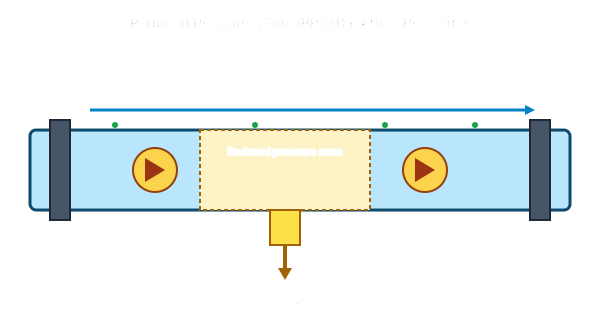
Reduced-Pressure Zone assembly (RPZ). Two spring-loaded check valves with a pressure-monitored zone in between, plus a relief valve that vents to atmosphere if back-pressure tries to develop. Protects against both back-pressure and back-siphonage, including high-hazard contaminants. Required annual testing by a certified backflow tester. Installed above-grade with clearance around the relief valve.
Double Check Valve Assembly (DCVA). Two spring-loaded check valves in series. Protects against both back-pressure and back-siphonage, but only for non-health-hazard (low-hazard) cross-connections. Smaller and cheaper than an RPZ. Annual testing required.
Pressure Vacuum Breaker (PVB). Spring-loaded check valve with an air inlet that opens when supply pressure drops. Protects against back-siphonage only — not back-pressure. Must be installed at least 12 inches above the highest downstream outlet. Annual testing required.
Atmospheric Vacuum Breaker (AVB). A simpler vacuum breaker with no check valve. Protects against back-siphonage only. Must be installed at least 6 inches above the highest downstream outlet, and cannot be under continuous pressure — has to be installed downstream of any shutoff valve. No testing required, but very limited use cases.
Now the scenarios.
Scenario 1: Garden hose submerged in a swimming pool
The setup. A homeowner fills a pool with a garden hose, leaves the hose end submerged below the water line, and walks away. A water main break or upstream hydrant flushing creates negative pressure in the service line.
The cause. Back-siphonage. The vacuum in the supply line pulls pool water — chlorine, dirt, swimmer bacteria — backward through the hose and into the home's plumbing, then potentially into the distribution main.
The fix. A hose bib vacuum breaker (HBVB) — basically a small atmospheric vacuum breaker that screws onto every outdoor hose connection. Required by most plumbing codes on new construction and a common retrofit on older homes. The HBVB is a non-tested, code-required device that costs about $5.
Exam answer pattern. Question gives a hose-bib scenario → answer is atmospheric vacuum breaker or hose bib vacuum breaker. Don't pick RPZ for this — it's overkill for a low-hazard residential connection.
Scenario 2: Boiler with chemical treatment additive
The setup. A commercial building has a hot-water heating boiler with corrosion-inhibitor chemicals added to the loop. The boiler is fed from the city water supply for makeup. The boiler operates at 30 psi when the building's incoming pressure is 60 psi.
The cause. Back-pressure (chemical hazard). If the city pressure drops below 30 psi — boil-water break, peak demand event, downed pump station — the boiler's pressure pushes the chemically-treated water back into the city supply.
The fix. RPZ (Reduced-Pressure Zone assembly). This is a high-hazard cross-connection because of the boiler chemicals, and there's back-pressure potential, so DCVA isn't sufficient. RPZ is required by virtually every state plumbing code on commercial boiler makeup lines.
Exam answer pattern. "Boiler" + "chemical additive" → RPZ. The only acceptable answer.
Scenario 3: Hose bib at a car wash with detergent injector
The setup. A car wash has a hand-held wand fed from city water. The wand has a chemical injector that mixes soap into the spray stream. The hose runs from the building wall to the wand.
The cause. Back-siphonage and a high-hazard chemical contaminant. If supply pressure drops, the soap concentrate could be siphoned back into the building's water supply. (Some setups also involve back-pressure when the chemical pump is running.)
The fix. RPZ on the supply line to the car-wash spray station. The chemical injector qualifies as a high-hazard connection, so an air gap or RPZ is required — not a PVB, not a DCVA. Some car washes use air gaps (a break tank with float valve) instead of RPZs.
Exam answer pattern. Any "chemical-injected spray" or "wand with chemicals" → RPZ.
Scenario 4: Lawn irrigation system with fertilizer or pesticide injection
The setup. A property uses an irrigation system fed from city water, with a fertilizer or pesticide injector that mixes chemicals into the irrigation flow downstream of the supply.
The cause. Back-siphonage at minimum; sometimes back-pressure depending on the irrigation pump configuration. The chemicals are a high-hazard contaminant.
The fix. RPZ if the system is under continuous pressure or has back-pressure potential. PVB if the irrigation system has no booster pumps and the injector is downstream of the PVB at least 12 inches.
In practice, RPZ is the safer choice for any chemigation system because it covers both back-siphonage and back-pressure. The exam question often asks specifically about back-pressure capability — that's the tell that the answer is RPZ, not PVB.
Exam answer pattern. "Irrigation" + "chemical injector" + "high hazard" → RPZ. Without chemicals (plain irrigation), PVB or DCVA is acceptable.
Scenario 5: Fire sprinkler system with antifreeze loop
The setup. A building has a wet-pipe fire-sprinkler system fed from the city supply. A portion of the system runs through an unheated attic, so antifreeze (propylene glycol or similar) is mixed into that loop.
The cause. Back-pressure from the elevated sprinkler riser, plus potential back-siphonage if the city pressure drops. Antifreeze is a chemical hazard.
The fix. RPZ. Antifreeze qualifies as a chemical contaminant, so RPZ is required by NFPA 13 for any fire-sprinkler system with chemical additives. Without antifreeze, a DCVA is acceptable for low-hazard fire-sprinkler protection (plain water).
Exam answer pattern. "Fire sprinkler" + "antifreeze" → RPZ. "Fire sprinkler" + "plain water" → DCVA.
Scenario 6: Hospital sink with vacuum aspirator
The setup. A hospital sink or laboratory bench has a vacuum aspirator powered by water — a venturi device that uses water flow to create suction for medical procedures. The aspirator's vacuum line could potentially backflow contaminated material into the supply.
The cause. Back-siphonage (the entire device works by creating vacuum) combined with severe high-hazard contaminants (blood, body fluids, infectious agents).
The fix. Air gap. This is one of the few scenarios where exam questions specifically rule out mechanical preventers and require a physical air gap. Hospital plumbing codes require an air gap between the contaminated outlet and the water supply for any medical aspirator or vacuum suction equipment.
Exam answer pattern. "Hospital" + "vacuum aspirator" or "medical aspirator" → air gap. RPZ is sometimes acceptable as a secondary protection but air gap is the primary answer.
Scenario 7: Industrial wash bay or chemical-process water connection
The setup. An industrial facility has a wash bay where parts are sprayed with both water and chemical cleaning agents, with a pressurized rinse cycle that operates at higher pressure than the city supply. Or alternatively, a process tank that receives city water and contains industrial chemicals.
The cause. Back-pressure (the rinse cycle's booster pump pressure) combined with severe high-hazard chemicals (degreasers, acids, caustics, solvents).
The fix. Air gap or RPZ. Air gap is preferred — usually via a break tank where city water fills the tank with an air gap, and a separate pump pressurizes the wash system. Where air gap isn't possible, RPZ is the alternative.
Exam answer pattern. "Industrial" + "chemical" + "pressurized" → air gap (preferred) or RPZ. Never DCVA for high-hazard industrial connections.
Common mistakes on cross-connection exam questions
These trip up operators on the certification exam more than any other cross-connection topic.
- Picking DCVA when the scenario is high-hazard. DCVA is for low-hazard (non-health-threatening) cross-connections only. Any chemical, biological, or thermal hazard pushes the answer to RPZ or air gap.
- Picking PVB or AVB when back-pressure is in the scenario. PVB and AVB protect against back-siphonage only. If anything in the question mentions a pump, elevated tank, boiler pressure, or pressurized downstream system, the answer is RPZ — not PVB.
- Forgetting the installation requirements. PVB must be at least 12 inches above the highest downstream outlet. AVB at least 6 inches. RPZ installed above-grade with clearance for the relief valve. Exam questions sometimes test these specific clearances.
- Confusing testing requirements. Air gap = no testing (no moving parts). RPZ, DCVA, PVB = annual testing by certified backflow tester. AVB = no testing because it has no check valve.
- Treating "back-pressure" and "back-siphonage" as the same thing. They're caused by opposite hydraulic conditions and require different devices in some cases. The exam tests this distinction directly.
- Picking the wrong-hazard device for residential outdoor faucets. Residential hose bibs are low-hazard in most code definitions, so a hose bib vacuum breaker (HBVB) is correct — not RPZ.
- Skipping the chemical-hazard rule. Anywhere chemicals could enter the water (boilers, irrigation injectors, car washes, fire-sprinkler antifreeze, industrial cleaning), the answer is RPZ or air gap. There's no scenario where chemicals + DCVA is correct.
A 30-second decision flowchart
When you read a cross-connection question on the exam, run through it in this order:
- Is there a chemical, biological, or thermal hazard? Yes → narrow to RPZ or air gap. No → DCVA, PVB, or AVB.
- Is there back-pressure potential (boilers, booster pumps, elevated tanks)? Yes → eliminate PVB and AVB. They're back-siphonage only.
- Is the device under continuous pressure? If continuous pressure + no back-pressure + low hazard → PVB. If not under continuous pressure → AVB. If high hazard → RPZ.
- Is an air gap physically possible in the scenario? On any high-hazard scenario, prefer air gap as the answer. RPZ is the fallback when air gap isn't workable.
That decision tree solves the majority of cross-connection exam questions in well under a minute.
Where to read more
The authoritative reference is the AWWA M14 manual, Recommended Practice for Backflow Prevention and Cross-Connection Control. The University of Southern California's Foundation for Cross-Connection Control and Hydraulic Research (FCCCHR) publishes the official approval list for backflow preventers in the US. EPA's Cross-Connection Control Manual (publication 816-R-03-002) is freely available and covers the same scenarios in more detail. Your state primacy agency or plumbing code may have additional requirements specific to your jurisdiction.
Practice what you learned
Cross-connection questions come in two flavors: scenario-recognition (what is this — back-pressure or back-siphonage?) and device-selection (which preventer fixes this?). Both kinds appear on every level of the operator exam.
Run the free cross-connection control practice test for the scenario questions, and the free regulations practice test for the code-citation questions (which sections of the Safe Drinking Water Act apply, which state authority enforces backflow rules, etc.). Once you can pattern-match a scenario to the right preventer in under 30 seconds, you're ready for the exam.